12-Week Gran Fondo Build for Masters: Blocks, Not Weeks
8 November 2026
Gran Fondo Race Day Tactics: Pacing, Position, Final Hour
12 November 2026
AI-generated header image for: Which Test Finds the Limiter: Lactate, VO2 Max or Metabolic?
You have done the intervals. You have logged the TSS. Yet your FTP has not moved in months. Before you add more volume, consider that the problem may not be your training. It may be your diagnosis. Three tests get marketed to amateurs as if they were interchangeable: blood lactate testing, VO2max testing, and full metabolic panels. They are not. Each measures something different, and a single number will never name your limiter. VO2max tells you the ceiling, not the cause. Blood lactate testing shows how your body handles intensity, but it misses fat oxidation and threshold dynamics. A full metabolic panel combines the variables that actually explain why you are stuck. This piece separates what each test can and cannot detect. We will cover the four variables every test is trying to measure, the real reliability of VLamax, a side-by-side comparison, and a decision path by rider type. If you want to stop guessing and book the right test, start with a Cycling Breakthrough Call. Our guarantee: +30 W FTP in 6 months with at least 80% session completion.
Why Your FTP Plateau Is a Diagnosis Problem, Not a Training Problem
FTP (functional threshold power, the highest power you can hold for about an hour, in watts and W/kg) is an outcome, not a cause. When it stalls, something upstream caps it; more threshold intervals will not reveal what.
Four variables sit upstream: VO2max (aerobic ceiling), VLamax (the maximal rate glycolysis produces lactate), MLSS (maximal lactate steady state, the highest power where lactate production and clearance balance, which FTP only approximates), and fat oxidation (fat burned per hour at a given intensity).
Two riders can hold the same FTP with opposite limiters: one capped aerobically, the other running a glycolytic engine that burns carbohydrate hard and pushes blood lactate up early. Both get sold the same generic plan, which is why durability work matters for masters riders chasing a stalled FTP.
The question before you pay for a test is not which test is best, but which combination separates those four variables. FTP should not be considered a threshold marker between heavy and severe intensity; a single number cannot name your limiter. Treating blood lactate, metabolic and VO2 max testing as interchangeable is a market pattern, not a research finding.
The Four Variables Every Test Is Trying to Measure
Every test samples some slice of four variables.
VO2max is the maximum rate your body can take up and use oxygen, reported in liters per minute and milliliters per kilogram per minute (ml/kg/min). It sets the aerobic ceiling your sustainable power can never exceed.
VLamax is the maximal glycolytic rate, measured in millimoles of lactate per liter per second (mmol/L/s). It governs how much carbohydrate you burn and how fast lactate accumulates, which is why a high-VLamax rider feels punchy but runs hot on long rides.
MLSS, maximal lactate steady state, is the highest power you can hold with lactate production and clearance in balance. It is the physiological anchor FTP only approximates from a field test.
Fat oxidation is grams of fat burned per hour at a given intensity, peaking at FatMax. Over a four to seven hour event, it decides how much glycogen survives to the final climb.
These interact. The same VO2max with a different VLamax produces a completely different rider: one wins a 30-second kick, the other holds steady power in hour three of an Alpine col. The useful information is in the combination, not in any single number.
Blood Lactate Testing: What It Sees and What It Misses
Those four variables matter only if a test can see them.
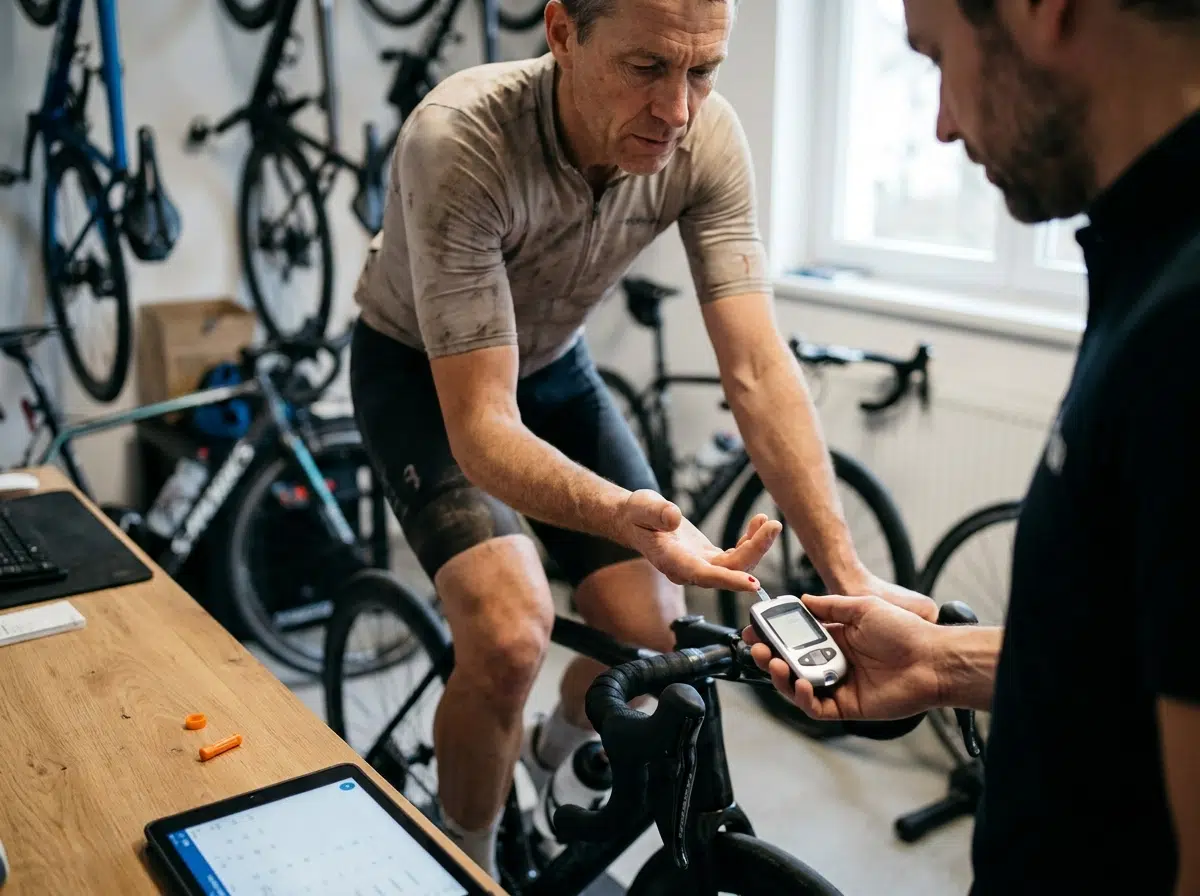
After a controlled warm-up, you ride fixed three-to-five-minute steps at increasing watts on a trainer, sampling capillary blood from a fingertip or earlobe in the last 30 to 60 seconds of each step, then plotting lactate (mmol/L) against power.
That curve reveals LT1, the first sustained rise above baseline and your aerobic threshold, plus LT2, which tracks close to MLSS; modelled LT2 agrees moderately well with MLSS in cycling. It captures how individual your response is, which is why it beats percentage-of-FTP guesswork for setting zones.
Practical strengths: least expensive, most repeatable, light enough on a training week to repeat mid-block and confirm a plan is working.
What it misses: without gas exchange there is no VO2max and no ventilatory thresholds. Substrate use can only be inferred, and VLamax is modelled, not measured.
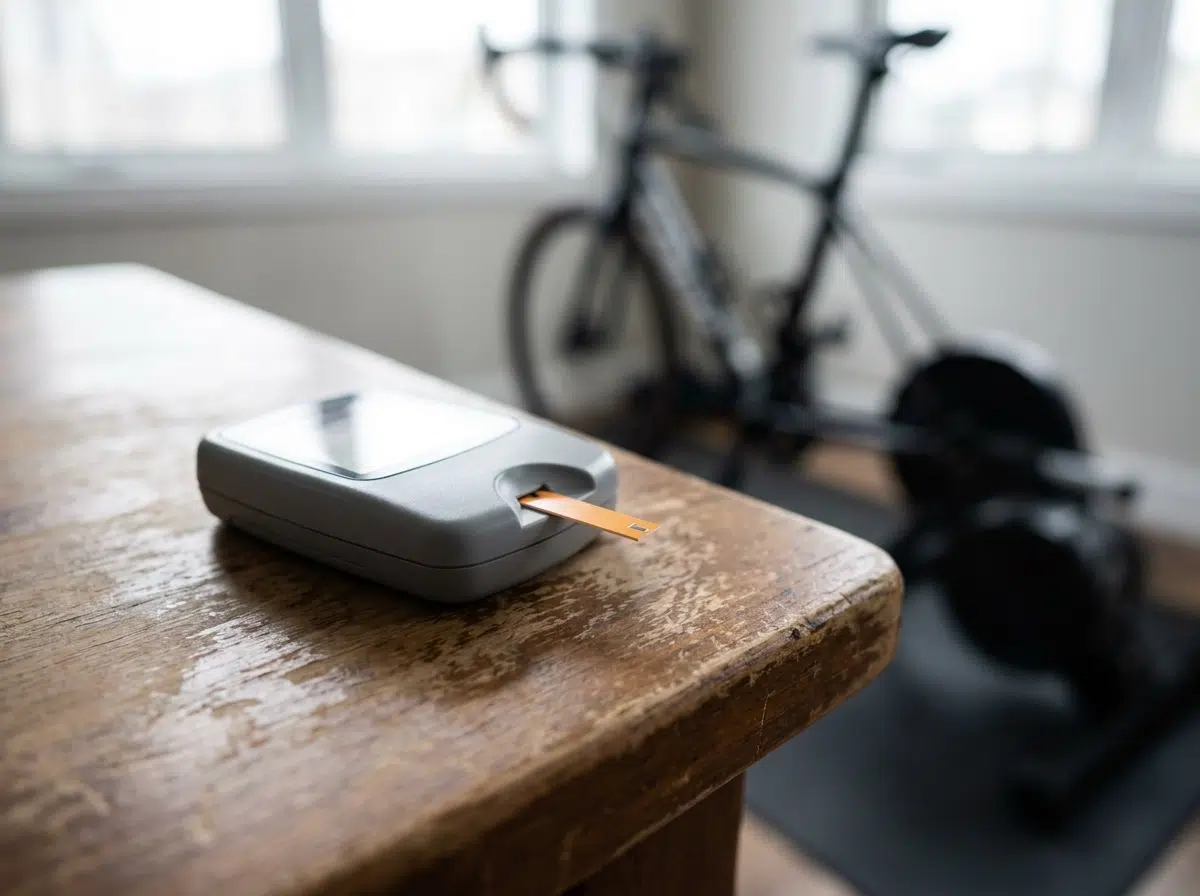
Hydration, glycogen status, caffeine, finger-prick technique, meter calibration and step length all shift the curve. Our six-month premium program ships a lactate meter so testing happens at home under consistent conditions, not a one-off lab appointment.
VO2 Max Testing: The Ceiling, Not the Cause
Blood lactate testing maps the curve; gas exchange measures the ceiling.
You wear a face mask on a metabolic cart and ride a ramp to exhaustion while the system measures oxygen uptake (VO2), carbon dioxide production (VCO2), ventilation and the respiratory exchange ratio (RER, CO2 produced over O2 consumed) using cardiopulmonary exercise testing, showing whether you lean on fat or carbohydrate.
It reports your aerobic ceiling in liters per minute, in ml/kg/min and in watts at VO2max, plus ventilatory thresholds (VT1 and VT2) and efficiency: watts produced per liter of oxygen consumed.
What it misses: VLamax. A rider can post an excellent ml/kg/min number and still fade because the glycolytic side drains glycogen and drives lactate up. It also gives no direct MLSS, only ventilation-derived thresholds.
Where to book: a VO2 max test near me search surfaces university performance labs and hospital sports medicine departments. Insist on a true ramp to exhaustion with gas exchange, not an estimated field protocol.
One visit is a snapshot, trustworthy only with fresh calibration, a genuinely maximal effort and clean pacing. It tells you where you stand, not which variable to train next.
Metabolic Testing: The Combination Panel That Names the Limiter
The panel answers what the ceiling test left open. A full metabolic panel combines three measurements: gas exchange for VO2max and ventilatory thresholds, a graded lactate test for your lactate curve, and a short maximal sprint, often 15 seconds, from which glycolytic rate and VLamax are calculated.
What a single ceiling number cannot show, the panel does: VLamax, MLSS and threshold power, fat and carbohydrate oxidation rates across intensities, and above all the relationship between them. That relationship names the limiter.
High VO2max with high VLamax means you burn glycogen hard and lactate rises early, so lowering VLamax converts aerobic capacity into climbing performance. High VO2max with low VLamax is the diesel profile, where pushing MLSS or the ceiling moves you further.
Our method: metabolic lactate profiling with INSCYD, then 1:1 remote coaching, then retesting under identical conditions to confirm the limiter moved. That is our coaching methodology, not a research finding.
Limits: still a snapshot, it requires a rested and well-fuelled athlete, and it justifies the cost only if you plan to retest and act on it.
How Reliable Is VLamax, Really?
VLamax is not measured. It is calculated from a short sprint and the lactate response that follows, so it inherits the error of both the power data and the lactate reading. That matters when you decide how much weight to give it.
A peer-reviewed study of 18 men and 12 women who completed two sprint sessions one week apart (Physiologia 2023, 3(4), 542 to 551) makes the gap concrete. Sprint power was highly reproducible, with a coefficient of variation of 4.7 percent. VLamax was only moderately reliable: CV 18.6 percent, ICC 0.661, r = 0.67.
Treat a single VLamax value as a direction, not a decimal place. Look for trends across repeated tests rather than reacting to a small shift that could be measurement noise.
To make tests comparable, keep the protocol identical: same sprint duration, same recovery, same lactate meter, same time of day relative to meals and hard training.
The science is still open. A 2025 Sports Medicine commentary asks whether VLamax plays for glycolysis the role VO2max plays for oxidative phosphorylation. Useful measurement, not settled doctrine, and never the only number you act on.
What No Single Number Can Tell You
Diagnosis needs more than one number. Blood lactate testing sees the lactate curve and thresholds; a VO2 max test sees the aerobic ceiling and ventilation; only a combined panel sees VLamax, MLSS and substrate use.
Two riders with identical VO2max can need opposite training. One must reduce VLamax to stop burning through carbohydrate; the other needs a higher aerobic ceiling because the glycolytic side is sufficient.
Fat oxidation is the quiet limiter over four to seven hours at the Etape du Tour, La Marmotte or a 100 mile (161 km) US gravel race. Whoever spares glycogen is still moving on the final climb, and VO2max says nothing about that.
Masters riders aged 40 to 60 face a specific mix: the aerobic ceiling declines and responds slowly, while threshold, lactate handling and fat oxidation still adapt. Testing shows where a limited ten hour week pays.
A limiter moves. Once training shifts VO2max or VLamax, the constraint changes, and without a retest you cannot separate a working plan from normal form fluctuation. The real limiter is the variable that, in combination with the others, releases the most performance when it moves.
Side by Side: What Each Test Detects, Misses and Fits
No single test wins outright; each covers a different slice of the same system.
| Test | Measures directly | Detects | Misses | Best used when |
|---|---|---|---|---|
| Blood lactate | Lactate curve, thresholds | LT1, LT2, individual response | VO2max, substrate oxidation | First look, accurate zone setting, frequent retests |
| VO2 max (gas exchange) | Oxygen uptake, ventilation, RER | Aerobic ceiling, ventilatory thresholds, efficiency | VLamax, true fat oxidation rates | You need to know how much aerobic headroom exists |
| Full metabolic panel | Gas exchange, lactate curve, sprint-derived glycolytic rate | All four variables plus their interaction | Little, but still a snapshot | Plateau survived several structured plans, or event has a specific metabolic demand |
Read the misses column first. That is usually where your limiter hides: a test that cannot see VLamax cannot tell you VLamax is the problem.
Commitment rises in the same order. Lactate testing is the least disruptive and most repeatable, a VO2 max test is one lab visit, and a full panel is the biggest investment with the largest information gain.
Choosing Your Test: A Decision Path by Rider Type
Match the test to your history, not the marketing.
New plateau, under eight to ten hours a week: start with blood lactate testing. Build zones from your own curve, then retest in eight to twelve weeks to see whether the limiter moved.
Plateau that survived two or more structured plans: go straight to full metabolic profiling. Effort and plan quality are not the problem; an unmeasured variable is.
Target event beyond four hours, or you fade in the final two: weight fat oxidation and VLamax heavily. Threshold numbers alone will not explain a fueling collapse on a long climb.
Never measured aerobic capacity, especially at 40 plus: a gas-exchange VO2 max test returns the ceiling, both thresholds and efficiency in one visit, plus a benchmark you can retest.
Wherever you book, ask four questions: Is VO2max measured by gas exchange or estimated? Is VLamax derived from a sprint protocol? What is the lactate step protocol, and how many steps? Does the price include interpretation and retesting? Protocol details decide whether your numbers are comparable at all.
Booking Notes for US and Swiss Riders
Once you’ve chosen, logistics decide whether the data means anything. US labs report power in watts and W/kg, body mass in pounds with kilograms in brackets, and oxygen uptake in ml/kg/min. Bring your own power files, and note lab altitude: 5,000 feet (1,524 m) reads differently than sea level. Swiss testing is metric, priced in CHF, and Alpine labs often sit at altitude themselves. Targeting the Grimsel, Furka and Susten? Ask for fat oxidation data alongside thresholds.
Either way, confirm the quote includes gas exchange, lactate analysis and a written interpretation, and whether the same tester runs your retest. Comparability between visits beats the first absolute number.
Finally, do not test fatigued, glycogen depleted or mid heavy block. A controlled warm-up, consistent fueling beforehand and a genuinely maximal effort are what make the fee worth paying. With clean conditions, the numbers become training decisions.
Turn the Numbers Into Training
Booking is step one; the real work is diagnosis. Name the variable capping your FTP, then train it. No single number does that.
Start where your question and budget point you. Blood lactate testing sets zones and repeats cheaply. A VO2 max test quantifies your aerobic ceiling. A full metabolic panel earns its cost once a plateau has outlasted more than one structured plan.
Whatever you book, schedule the retest at the same time. A limiter only means something when you can demonstrate it moved.
For the full picture, our six-month premium coaching program pairs INSCYD metabolic lactate profiling with 1:1 remote coaching and a lactate meter shipped to you for home testing. We guarantee a minimum of +30 W FTP in six months provided you complete at least 80 percent of prescribed sessions, and we take a maximum of four new athletes per month. Book a Cycling Breakthrough Call
Conclusion
No single number finds your limiter. Blood lactate testing builds zones affordably, VO2 max testing defines your aerobic ceiling, and a full metabolic panel names the variable actually capping FTP, which matters most once a plateau has survived more than one structured plan. Whatever you book, retest under identical conditions, because a limiter only counts when you can show it moved.
Next step: if your plateau has outlasted a sensible plan, our six-month premium coaching program pairs INSCYD metabolic lactate profiling with 1:1 remote coaching and a lactate meter shipped to you for home testing. We guarantee a minimum of +30 W FTP in six months with at least 80 percent session completion, and we take a maximum of four new athletes per month. Book a Cycling Breakthrough Call, name your limiter, then train it: https://waytochamp.com/schedule