
What Is Lactate Testing? What Your Curve Really Says
6 November 2026
Which Test Finds the Limiter: Lactate, VO2 Max or Metabolic?
10 November 2026
AI-generated header image for: 12-Week Gran Fondo Build for Masters: Blocks, Not Weeks
If you are 40 to 60, riding eight to twelve hours per week, and still chasing a faster gran fondo, the weekly template is probably your limiter. More intervals rarely fix it. Better placement of intensity inside a fixed volume usually does. This tutorial lays out a 12-week gran fondo build for masters cyclists, organized as blocks, not weeks. You will see why the weekly template stalls, how one target adaptation and one measurement point per block keeps progress honest, and why volume stays flat while intensity moves. We cover what the evidence supports and what it does not, then detail four blocks: aerobic base and fat oxidation; FTP, the power you can hold for about an hour, and MLSS, the hardest steady effort before lactate rises; VO2max, your aerobic ceiling, and fatigue resistance; durability and event-specific load. You also get event-week guidance for pacing long climbs and carbs per hour, the weekly structure inside every block, where this build fits in your season, and a self-test to measure adaptation rather than effort. For a coached next step, book a Cycling Breakthrough Call: https://waytochamp.com/schedule. Our official guarantee is +30 W FTP in 6 months with at least 80% session completion.
Why the Weekly Template Stalls Masters Cyclists
A weekly template repeats the same interval pattern for 12 weeks. It assumes your recovery capacity in week 2 matches week 10. Evidence suggests, and most masters athletes report, that after 40 the same session costs more fatigue and that fatigue lingers longer, so the plan quietly accumulates load you cannot absorb.
With 8 to 12 hours, volume is not a lever. If your FTP (the highest power you can hold for roughly an hour) has not moved in a year, the fix is a different distribution of the same hours, not more hours.
Gran fondo cycling events do not reward fresh-leg power. Events that typically run 4 to 7 hours with extended climbing sections are decided by what you can hold in hour four. Coaches call that durability, or fatigue resistance. For masters riders, it is as much a strength problem as a metabolic one, which is why durability work for masters cyclists belongs in the plan.
Templates optimize the workout. Blocks optimize the adaptation. Without a named target (fat oxidation, MLSS, VO2max, durability) and a fixed measurement point, you cannot separate progress from noise.
Vocabulary, used consistently from here: FTP, TSS (a score of how much training stress a ride carries), CTL (a rolling average of that stress, your fitness trend), and W/kg (power relative to body weight, the number that decides climbing speed).
The Block Principle: One Target Adaptation, One Measurement Point

Block periodization concentrates one or two abilities into a window of one to four weeks while everything else is maintained. It inverts the weekly template’s habit of touching every quality every week: Issurin describes block periodization as highly concentrated loads aimed at a minimal number of abilities, rather than developing many simultaneously.
One target adaptation: each block carries exactly one physiological objective. Examples are raising fat oxidation, lifting MLSS (maximal lactate steady state, the highest power where blood lactate stops rising), expanding VO2max (your ceiling for aerobic power), or building durability.
One measurement point: same protocol, same conditions, at the end of the block. A block without a measurement is a guess with a training plan attached to it.
Label this honestly: the one-target, one-measurement structure is Way2Champ’s coaching method, not a published study finding. The underlying block concept is supported in the literature; the packaging is ours.
Maintenance work inside a block is deliberate, not wasted. Adaptations persist after direct training stops, at different decay rates per quality: residual training effect data put maximal speed at roughly 5 ±3 days and strength endurance at 15 ±5 days. So one threshold touch in a base block, and one long ride inside a VO2max block, stop the other qualities from decaying while the target moves.
Every block below applies this structure.
Volume Stays Flat, Intensity Moves
Hold total hours constant at 8 to 12 per week for all 12 weeks. Every block changes the shape of the week, not the size of it: the same eight to twelve hours, redistributed.
The distribution inside those hours follows a polarized pattern of roughly 75 to 80 percent low intensity and 10 to 15 percent high intensity, the guidance cited in the block periodization literature (polarized training research). That is the whole argument. In a normal block week, one hard session plus the long ride carries the adaptation. In the concentrated week inside a block, hard sessions stack and endurance volume is cut to make room for them.
For a rider aged 40 to 60, fatigue is a fixed budget. Moving intensity spends that budget differently, which is why redistribution is safer than adding sessions to a template.
With volume fixed, the question becomes what the evidence actually supports about moving intensity.
What the Evidence Supports, and What It Does Not
One study anchors the block-versus-template case: 12 weeks of block periodization against a traditional layout in well-trained cyclists, eight riders versus seven. Relative VO2max improved 8.8 ± 5.9% with blocks against 3.7 ± 2.9% with the traditional plan (P < 0.05). Power at 2 mmol/L lactate, a practical stand-in for the first threshold, where lactate stops accumulating steadily, rose 22 ± 14% versus 10 ± 7%, though that difference was a tendency only (P = 0.054). The same trial reports moderate effects in favor of blocks across VO2max, power at 2 mmol/L, hemoglobin mass and 40-minute all-out power, with effect sizes of roughly 0.62 to 1.12, as reported in the 12-week block periodization study.
The mechanism matters more than the headline. The block group achieved these results by redistributing the same work, the same eight to twelve hours, concentrated differently.
Now the limits, in the same breath. Eight and seven riders is a small sample. The participants were well-trained cyclists; the study says nothing about 8 to 12 hour weeks or recovery in older athletes. Treat it as support for the concept, not proof for your population. That is why every block below carries its own measurement point instead of trusting the model.
The 12-Week Gran Fondo Build at a Glance
Those limits do not undermine the sequence; they make it a coaching template, not a research guarantee.
Table 1. Block overview
| Block | Weeks | Target adaptation | Key measurement | Volume |
|---|---|---|---|---|
| 1 | 1-3 | Aerobic base, fat oxidation | Submaximal lactate check or 20-min test | 8-12 h held |
| 2 | 4-6 | MLSS, FTP | 20-min test or 30-min time trial | 8-12 h held |
| 3 | 7-10 | VO2max, fatigue resistance | 5-min power, durability index | 8-12 h held |
| 4 | 11-12 | Race-specific durability, fueling | Event simulation, carbs/hour tolerance | 8-12 h held |
Table 2. Block build vs. weekly template
| Element | Block build | Weekly template |
|---|---|---|
| Week to week | Shape changes by block | Same pattern repeats |
| Intensity added | Concentrated week in Blocks 2-3 | Fixed hard days |
| Intensity removed | Recovery after overload | Rarely adjusted |
| Progress verified | Test at each block’s end | Often never |
| Missed sessions | Drop endurance first; protect key sessions | Plan breaks |
Read both tables as a sequence, not a menu. Read the table as a sequence: each block assumes the previous one was completed. With 8 hours rather than 12, cut endurance rides, never key sessions, and never remove a measurement point. One climbing-heavy gran fondo cycling event on the calendar anchors all four blocks. With two events 6 to 8 weeks apart, run one full build and treat the second as a repeat of Blocks 3 and 4.
Block 1, Weeks 1 to 3: Rebuild Aerobic Base and Fat Oxidation
The tables set the sequence. Block 1 exists to make you a better fat burner, and that is a different job from making you stronger at threshold.
Target Adaptation: Fat Oxidation and Aerobic Efficiency
Fat oxidation is your capacity to produce power while sparing carbohydrate, so glycogen lasts deeper into a 4 to 7 hour gran fondo. That is what keeps hour four from becoming a survival exercise. VLamax, the maximum rate at which your body produces lactate, is worked around in this block, not pushed. Sessions stay below the point where lactate accumulates.
The Three Key Sessions
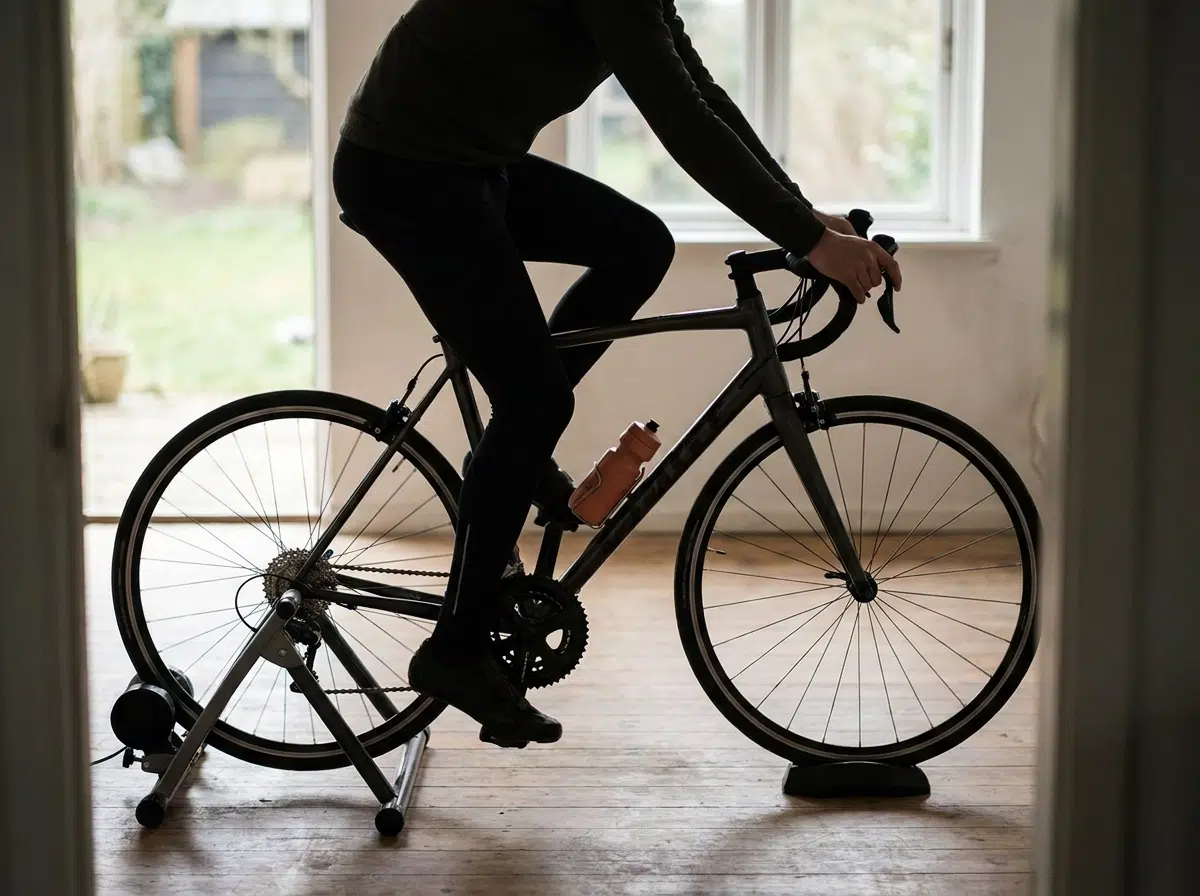
(The following sessions are Way2Champ’s coaching protocol, not findings from the cited studies.)
- Endurance with tempo inside: 3 to 4 hours at 60 to 70% FTP, with two 20 to 30 minute efforts at 75 to 80% FTP embedded in the ride. Once weekly.
- Low-cadence muscular endurance: 4 to 5 x 8 to 10 minutes at 75 to 85% FTP at 50 to 60 rpm. Builds torque and muscular endurance without high lactate accumulation.
- Maintenance touch: 6 x 1 minute at 110 to 115% FTP with 2 minutes easy between, once weekly, to hold top-end power while the base is rebuilt.
Measurement Point
Retest a 20 minute effort on a fixed course or trainer under identical conditions, plus a submaximal check. With a lactate meter or metabolic profile, compare power at 2 mmol/L against your previous test.
Mistake to Avoid
Turning a base block into a threshold block. If every ride has intervals in it, you skipped this block, and Block 2 will not deliver.
Block 2, Weeks 4 to 6: Raise FTP and MLSS
Block 1 rebuilt the engine; Block 2 makes it push harder. The target adaptation is MLSS, maximal lactate steady state: the highest power you can hold while blood lactate stays flat, and the practical ceiling on a 20 to 60 minute climb. On an Alpine climb it decides whether you ride at your pace or someone else’s. MLSS and FTP track closely but are not identical; if a lactate test puts your steady state below 95% FTP, anchor the intervals to MLSS power instead.
(The following sessions are Way2Champ’s coaching protocol, not findings from the cited studies.)
Three sessions carry this block.
Threshold 1: 2 x 20 minutes at 95 to 100% FTP, 8 to 10 minutes easy between. If 20 minutes does not repeat cleanly, ride 3 x 15 minutes.
Threshold 2: 4 to 5 x 8 minutes at 100 to 105% FTP with 4 minutes recovery, 32 to 40 minutes at or just above threshold.
Long ride: 2.5 to 4 hours at 60 to 70% FTP. Volume is not reduced to make room for intervals.
Measure at the end of week 6: 20-minute all-out effort or a 30-minute time trial on the trainer, same warm-up, same time of day. Record average watts, W/kg, and heart rate for the final 10 minutes.
In our experience, adding a third threshold session does not raise FTP faster; it shows up as a flat Block 3, where you need fresh legs for VO2max work.
Block 3, Weeks 7 to 10: VO2max and Fatigue Resistance
Block 2 left you with threshold fitness and a neuromuscular cost. Take 3 to 4 easy days before the first hard session. Doing VO2max intervals on legs still carrying Block 2 fatigue produces below-target numbers you will misread as a failed adaptation.
Target adaptation. VO2max, your ceiling on aerobic power, plus fatigue resistance: the ability to hold high submaximal power after three or more hours in the saddle. These are the two demands a gran fondo actually imposes.
(The following sessions are Way2Champ’s coaching protocol, not findings from the cited studies.)
Session 1: 5 x 3 minutes. At 115 to 120% FTP with equal recovery, full recovery between reps, cadence 95 to 105 rpm. Once per week. The goal is time at high oxygen uptake, not lactate accumulation.
Session 2: 30/15s. 30 seconds at 120 to 130% FTP, 15 seconds easy, for 10 to 12 minutes, repeated 2 to 3 times. This format accumulates time near VO2max without any single long effort, so the cardiovascular stimulus stays high while the muscular cost stays manageable.
Session 3, the durability session. 4 to 5 hours easy, then 2 x 20 minutes at threshold inside the final hour. This is the session that most closely resembles a gran fondo, and the one Block 4 depends on.
Concentrated week. Following the concentrated-block logic described earlier, apply one overload week here, as a coaching guideline cutting endurance volume by roughly a third, then take two easy days.
Measurement point. Track 5-minute best power and a durability index, the percentage of your fresh 20-minute power you can still hold after 3 hours (a practical tracking metric, not yet a formally validated measure). Both, not one. Block 4 then converts that ceiling into event-specific durability.
Block 4, Weeks 11 to 12: Durability and Event-Specific Load
Block 3 built the ceiling; Block 4 spends it. Weeks 11 and 12 convert fatigue resistance into event-specific durability: holding target power in hour four.
(The following sessions are Way2Champ’s coaching protocol, not findings from the cited studies.)
Key session 1: event simulation. Ride 4 to 5 hours with 3 to 4 climbs of 15 to 30 minutes at 85 to 95% FTP, placed after two hours, not at the start. Fresh-leg climbing proves nothing; a gran fondo decides itself late.
Key session 2: fuel rehearsal. Use the exact products and grams per hour you plan on event day, starting 20 minutes in. Log what your stomach tolerates at hour four, when gut blood flow drops. Multiple transportable carbohydrate sources, glucose plus fructose, oxidize at higher rates and are linked with less gastrointestinal distress than single-source fueling.
Key session 3: pacing matched to climb length. For 40-minute climbs such as Alpe d’Huez, Passo Gavia or Mount Washington (check current race data for your target event’s actual climb duration), ride 40-minute efforts at 88 to 92% FTP. For shorter climbs, ride shorter and harder.
Week 12 taper. Cut volume 40 to 50% as a coaching guideline, keep frequency, and hold two short touches of 3 x 1 minute at 110% FTP to stay sharp.
Measurement point: durability index (a practical tracking metric, not yet a formally validated measure) from the simulation, meaning late-ride power as a percentage of fresh 20-minute power, plus your fueling log in grams per hour, fluid and sodium. You reuse that log on event day.
Mistake to avoid: cramming. Week 12 sharpens and fuels. It is not a final fitness push you cannot absorb.
You now arrive at event week with the fueling plan already tested.
Event Week: Pacing Long Climbs and Carbs Per Hour in Gran Fondo Cycling Events
Block 4 sharpened you and rehearsed the fueling. Event week is execution, not fitness.
Taper: Follow the taper from Block 4: volume already cut, intensity touches already scheduled.
Pacing long climbs: as a pacing rule of thumb, ride the first third below threshold (85 to 90% FTP) and push the final third. Use W/kg as your reference, because the same watts cost more on steeper gradients and at altitude.
Do not chase the fast start. A common pattern among masters riders is losing more in the final hour than they gained by riding above sustainable power on the first climb.
Carbs per hour: over 4 hours, target 60 to 90 grams, starting within the first 30 minutes, as soon as you’re settled into your pace. Fueling is a trained skill. Fluid and sodium follow sweat rate and conditions.
Event notes: Etape du Tour and La Marmotte typically reward pacing discipline and fueling; Ötztaler is known for adding altitude and a cold start; long steady US climbs reward the durability built in Block 3.
What you keep between events is session types, not a fixed calendar.
The Weekly Structure You Keep Inside Every Block
Event week is over, but the structure underneath it never was event-specific. What stays constant across all four blocks is the shape of the week, not the calendar.
Session types, not weekdays. Your block decides how many endurance, threshold, VO2max, long ride, and strength sessions you get. Days are interchangeable; move a session rather than drop it.
As a practical ceiling for most masters riders, two hard sessions per week is the limit outside a concentrated week. Count the long ride as one of them. For most riders aged 40 to 60, a four-hour ride carries the fatigue cost of an interval day.
Strength. One to two sessions weekly, 3 to 4 sets of 5 to 8 reps at heavy but controlled loads. That dosing is Way2Champ’s masters protocol, not a research finding; it protects neuromuscular power and durability. Keep it through Blocks 1 to 3 and reduce it in Block 4 as event load rises.
Recovery. Sleep seven or more hours (current sleep-medicine consensus for adults generally recommends 7 to 9 hours). Take one full day off weekly. Ride short and easy the day after hard work. HRV and resting heart rate are inputs, not verdicts. One poor morning reading does not rewrite the plan.
Tools. Indoor trainers, Zwift, TrainerRoad, and TrainingPeaks execute and record sessions. They do not write progression. The block target and the measurement point come from your plan, not the app’s next workout.
Next, where this build sits inside your wider season.
Where the 12-Week Build Fits in Your Training Season
That weekly structure is the chassis. The 12-week build is one block inside a longer sequence: base, build, event, transition. Changing training seasons means changing the target, not just the date on the calendar: aerobic base in winter, threshold and VO2max in spring, durability and fueling into event week, then a transition period.
In our coaching experience, two builds per year is realistic at 8 to 12 hours. A third back-to-back build without a two-week reset usually produces a flat FTP and rising fatigue.
Work backwards from event week so it lands on the final week of the build. That sets your start date and tells you which cycling events are realistic this season. With two gran fondo cycling events 6 to 8 weeks apart, run one full build and treat the second as a shortened repeat of Blocks 3 and 4.
Individual limiters decide the emphasis inside the template. Metabolic profiling with lactate testing shows whether VO2max (your aerobic ceiling), VLamax (your maximal lactate production rate), fat oxidation or threshold is actually holding you back, which changes how much of each block you need. That is the difference between following a structure and following your structure.
Set the calendar first; the measurement protocol comes next.
Measure the Adaptation, Not the Effort: Your Self-Test
The block only counts if you can prove the target moved. Pick one protocol and repeat it under identical conditions: same fixed course or trainer, same warm-up, same time of day, same fueling.
Core test: 20 minutes all out. Record average watts, W/kg, average and maximum heart rate, and perceived effort.
Durability test: ride 3 hours of endurance, then 20 minutes all out. Durability index equals that power divided by your fresh 20-minute power (a practical tracking metric, not yet a formally validated measure). It is the number that predicts hour four of a gran fondo.
Metabolic check: a 2 mmol/L lactate step test or a full metabolic profile shows which limiter moved and by how much. Way2Champ ships a lactate meter to athletes in the 6-month coaching program, so testing happens at home between sessions.
Test at the end of each block, not weekly. Weekly testing measures noise; every 3 to 4 weeks measures adaptation.
Then let the data override the calendar. Back off when two or more signals agree: 20-minute power down 5% or more at the same perceived effort, resting heart rate up about 5 bpm, HRV trending down, or sleep and mood deteriorating. Two agreeing signals mean an easy week, not a new interval block. These are practical heuristics drawn from coaching practice; individual thresholds vary.
Conclusion: Fixed Volume, One Target Per Block
Testing tells you whether a block worked. What makes a block worth testing is one rule: hold volume flat, move intensity, and give every block one target adaptation and one measurement point. That is the entire method, and why 8 to 12 hours is enough.
Four blocks carry the 12-week gran fondo build: base and fat oxidation, MLSS and FTP, VO2max and fatigue resistance, then durability and fueling. Weekly hours never rise. Only the shape of the week changes.
Test at the end of every block with the same protocol, warm-up and time of day. The evidence supports this framework in trained cyclists; your own numbers are the proof.
Next step: book a Cycling Breakthrough Call to identify your limiter, set block targets and put measurement points on the calendar: https://waytochamp.com/schedule.