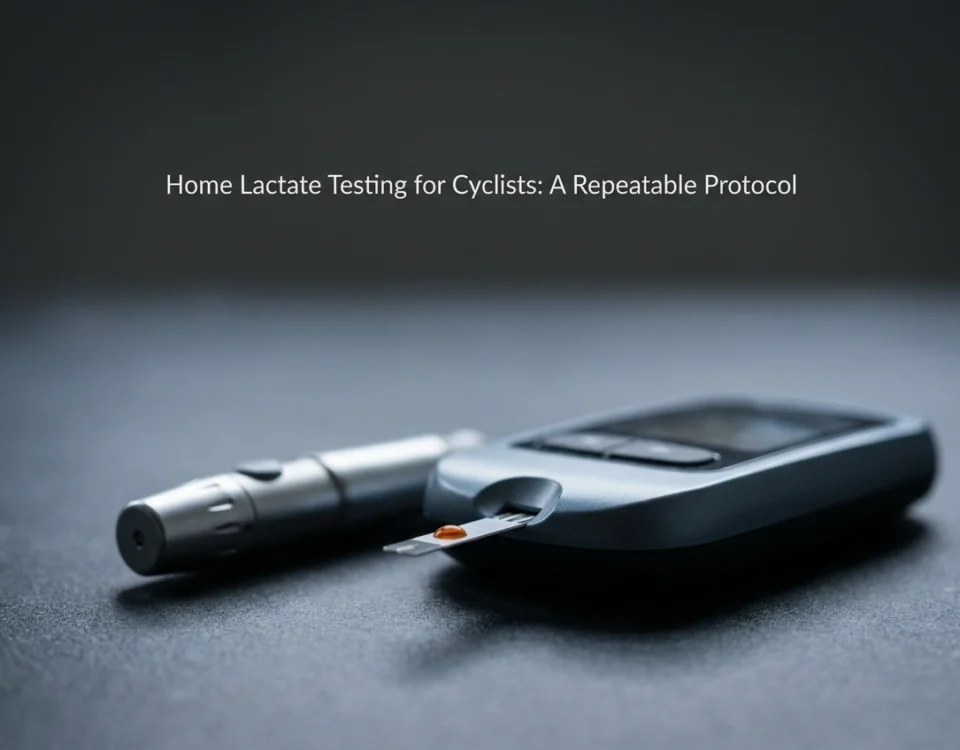
Home Lactate Testing for Cyclists: A Repeatable Protocol
14 November 2026
AI-generated header image for: How to Choose a Gran Fondo Coach, Not Just an App Plan
Most riders comparing coaching services are not comparing coaching. They are comparing plan delivery: how many workouts land each week, how polished the app looks, how fast the price is quoted. A plan is a template. A cycling coach is a diagnostician who finds your limiter, measures it, and owns the result.
The gap shows up when you have plateaued, when your FTP (functional threshold power, the highest power you can sustain for roughly an hour) has stopped moving, and when last season’s structure no longer produces adaptation. This post is a buyer’s checklist for judging any endurance coaching service on evidence rather than marketing. We will cover where the two models differ, why FTP alone cannot tell you what to fix, and five criteria: limiter diagnosis, re-testing cadence, session feedback speed, whether supporting specialists are real, and whether the outcome commitment is checkable. Way2Champ publishes a guarantee of at least +30 W FTP in six months with at least 80% session completion. Run the test before you pay, or book a Cycling Breakthrough Call to see how we answer it: https://waytochamp.com/schedule
A Plan Is Not a Coach: Where the Two Models Actually Differ

A service that only delivers a plan is a template, not coaching. With a template, the transaction ends at download. With a coach, it starts there.
That is economics, not malice. One plan, scaled across thousands of riders, is built around an average rider and adjusted by an algorithm and by how you felt that day. Nobody diagnosed why you stopped improving. A 2023 systematic review of interval training in trained cyclists concluded an individualized approach is warranted, and that prescription cannot be explained by interval type or duration alone.
Real coaching has five parts: diagnosis of your limiter, prescription aimed at that limiter, feedback on your actual files, re-measurement on a schedule, and accountability when life interrupts.
Your goal shows why this matters. A long sportive with significant climbing is a pacing, fueling and durability problem as much as a threshold problem. Generic plans are not built around your version of it.
What follows: five criteria, each with what real coaching does, what an app plan does, the question to ask any cycling coach, and what a weak answer sounds like.
Why FTP Alone Cannot Tell You What to Fix
FTP is the highest power you can hold for roughly an hour, and almost always an estimate from a 20-minute or ramp test. It is a proxy from a formula, not a direct measurement. Maximal lactate steady state (MLSS) is the hardest effort you can hold without lactate accumulating faster than you clear it, measured with actual lactate sampling. FTP estimates and MLSS do not always land at the same watt, that gap is where prescription goes wrong.
Four more numbers matter. VO2max is your aerobic ceiling, the size of the engine. In plain terms, VLamax is the maximum rate at which you produce lactate, which shapes your glycolytic power and how much carbohydrate you burn at a given intensity. Fat oxidation is how much energy comes from fat at a given intensity. W/kg, watts per kilogram, decides how fast you climb.
As an illustration, not as a sourced study, two riders at 3.5 W/kg can have opposite limiters. One needs VO2max work, one needs more time at MLSS, one needs to lower VLamax and burn less carbohydrate. Same headline number, three prescriptions.
For masters riders, shifting recovery windows and age-related aerobic changes mean the limiter worth attacking may differ from a younger rider’s, which is a reason diagnosis matters more, not less. Diagnosis comes before prescription.
Criterion 1: Do They Diagnose Your Limiter, or Assign You a Plan?
Real coaching runs a protocol that produces numbers specific to you, a lactate curve, power at MLSS, VO2max, VLamax, fat oxidation, then names your limiter in writing with the baseline value attached. An app plan slots you into zones and moves on.
So ask any provider one question before you pay: “What is my limiter, how did you measure it, and which number will change if we fix it?” A real cycling coach should answer that in a sentence.
Weak answers sound like this: “we build your zones from your FTP,” “everyone benefits from more threshold work,” “our algorithm personalizes the plan for you.” All three describe delivery. None describes diagnosis.
The pass standard is a named metric, a baseline value, a target value, and a date. Ask for it in writing. If a provider will not put it there, treat the conversation as a sales call rather than a diagnosis.
Criterion 2: What Gets Re-Tested, and How Often?
Re-testing is the only proof the plan is working. A plan sold once and never re-measured is an opinion with a spreadsheet attached.
What gets re-measured: the limiter itself, whether that is power at MLSS, VO2max, VLamax, or fat oxidation. Then FTP and W/kg as outcome markers, plus durability, how much power you still hold after three or four hours, which is what decides the last climb of a gran fondo.
Cadence: we recommend a scheduled re-test every 6–12 weeks, aligned to each training block, though the right interval depends on what you are measuring. Not “when you feel ready,” and not a single test at the end.
Ask the provider: “What exactly gets re-measured, on what date, and what result would change the plan?” If the answer is only “we retest FTP,” they are not measuring the thing they named as your limiter. Also ask what change exceeds measurement error, because even a reliable estimate can carry wide individual limits of agreement.
Home lactate testing, with a meter shipped to the athlete, is what makes remote re-testing on a real schedule workable for a masters rider with a job and a family.
Criterion 3: Who Reads Your Session Data, and How Fast?
Re-testing measures the arc. Session review measures the days between tests.
A dashboard can tell you that you hit, say, 92% of prescribed sessions and that your CTL (chronic training load, a rolling measure of accumulated training stress) is rising. That is load, not response. It cannot tell you whether the session produced the adaptation it was written for.
Human feedback looks different. Someone opens the file and comments on the actual watts, heart rate drift, cadence, and fueling, then connects it to the intended adaptation and the next session. Take a hypothetical: “The 4 x 8 minute efforts at 105% of FTP held power, but your heart rate drifted 9% by the fourth rep and you were under-fueled, so we shorten the intervals and raise carbs per hour.” That is coaching. “Great job” is not.
The question to ask any provider: “Who reviews my files, how often, and can I see an example of the feedback you write?” A provider with nothing to show has nothing to show. Weak answers include auto-generated session notes, feedback only when you ask for it, or promised contact that never gets scheduled. Ask when in the week the review happens, not whether it happens.
Criterion 4: Are the Supporting Specialists Real or a Logo Wall?
That same gran fondo is a fueling and position problem as much as a fitness one. Grams of carbohydrate per hour you can actually absorb, comfort and power after four hours in the saddle, sleep, HRV (heart rate variability, a recovery marker) and anything that needs referring out all sit outside the training plan itself.
The test is concrete: can they name the person, give you a route to reach them, state whether it costs extra or is included, and confirm the specialist sees your training data before advising?
Ask: “Who are the nutritionist, bike fitter and sports doctor, how do I access them, and is that included in the price?” A list of disciplines with no names is decoration.
The professional boundary matters. A coach coordinates and refers. They do not diagnose medical conditions or prescribe treatment, and a provider who blurs that line is a risk, not a feature.
Good coordination looks like one person holding the plan, with specialist input feeding back into the sessions you are prescribed rather than arriving as a separate report you have to interpret yourself.
Criterion 5: Is There a Checkable Outcome Commitment?
Specialists only matter if someone is actually holding the plan when life interferes. Accountability means weekly check-ins, follow-up when a session is missed, and a plan rewritten after work travel, illness or a bad night’s sleep costs you a week.
Then the harder test: a real outcome commitment names a number, a period, and its conditions. Way2Champ states a guarantee of a minimum +30 W FTP in 6 months provided the athlete completes at least 80% of prescribed sessions.
Ask: “What outcome do you commit to, over what period, and under what conditions?” Then read the conditions closely, because a guarantee with unstated terms is marketing copy.
Here is why the answer matters more than the pitch. A template model cannot predict what it will produce for you, which is precisely why most providers will not put a number on it. Ask anyway. Weak answers sound like “results vary,” “it depends on the athlete,” or “we focus on process rather than numbers,” with no figure anywhere in the reply.
A capped intake, such as a maximum of four new athletes per month, signals a model that depends on individual attention, but ask for the cap in writing rather than assuming it.
The Five-Question Scorecard for Any Cycling Coach
Carry these five questions into every call:
- What is my limiter, and how was it measured?
- What gets re-tested, and on what date?
- Who reads my files, and when?
- Who are the supporting specialists, and how do I reach them?
- What outcome do you commit to, over what period, and under what conditions?
Score one point per answer that names a metric, a person, or a date. Zero to two means you are being sold a template with a coach’s face on it. Three or four means structure with generic layers. Five means real coaching.
Ask for artifacts, not assurances: the written diagnosis, the re-test date on your calendar, a sample of written session feedback, and the guarantee terms in the contract.
Red flags in one place: no named limiter, no re-test date, feedback only on request, specialists unnamed or unreachable, no outcome commitment, and a monthly price quoted without scope attached.
Provider size is irrelevant. Whether you are evaluating elite athlete training services or a solo cycling coach for your sportive, the same five questions apply. Only specificity should move the needle.
How Way2Champ Answers Those Five Questions
To see what a full set of answers looks like, here is how one provider, Way2Champ, responds. It is one example, not a benchmark, and the guarantee below applies only under its stated condition.
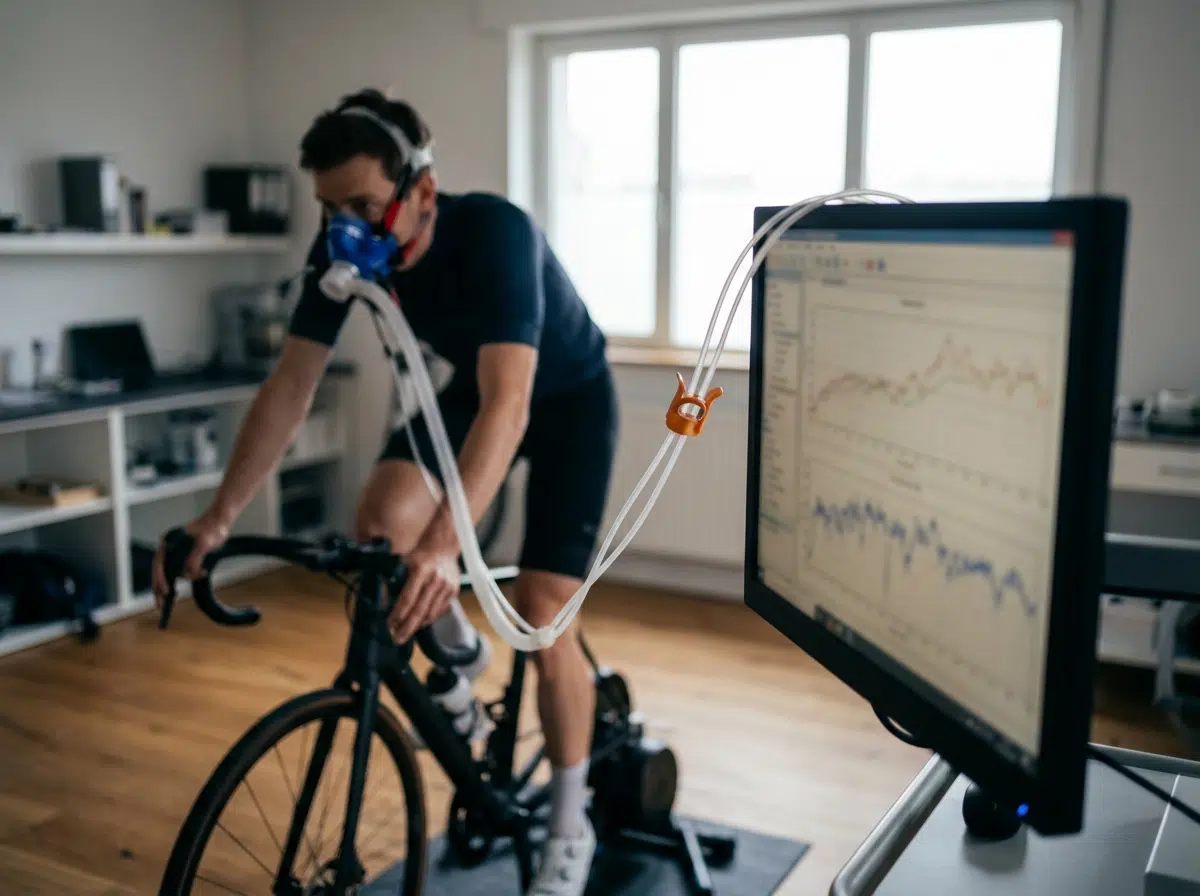
Diagnosis. Metabolic profiling using INSCYD aims to name the limiter, whether that is VO2max, VLamax, fat oxidation or threshold. Home lactate testing makes re-measurement possible without lab visits.
Coaching model. Fully individual 1:1 remote coaching with regular re-testing. Founded by Arek Kogut, a UCI-certified coach with extensive experience working with riders from first-time gran fondo riders to competitive athletes.
Supporting team. Way2Champ offers nutrition, bike fit and sports-medicine coordination alongside the training plan, plus camps in Spain and Italy for event-specific blocks before a target sportive.
Commitment and capacity. A 6-month premium program carries a stated guarantee of a minimum +30 W FTP in 6 months when at least 80% of prescribed sessions are completed.
Note the shape: metric, person, date, condition. Now run the same five questions past any provider you are considering.
Your Next Step: Run the Test Before You Pay
Run those five questions against your current setup this week.
Take your current coach, app plan, or self-coaching setup and answer each question honestly. A vague reply is your answer.
Conclusion
A plan assigns workouts; a coach finds your limiter, measures it, re-measures it on a date, reads your files, and commits to a number. FTP alone will not tell you what to fix, and supporting specialists or guarantees are only meaningful when they are specific and checkable.
Then act. Bring your most recent test data or best power numbers, the limiter you believe holds you back, and the date of your target gran fondo to a Cycling Breakthrough Call with Way2Champ. Get a straight answer on whether that limiter can be identified, re-measured, and moved within a defined period. Book at https://waytochamp.com/schedule. A vague reply is your answer; a specific one is your start line.