Can you get fit on just 3 rides a week?
9 July 2026
Granfondo Schweiz: San Gottardo, Villars und UCI-Serie
27 October 2026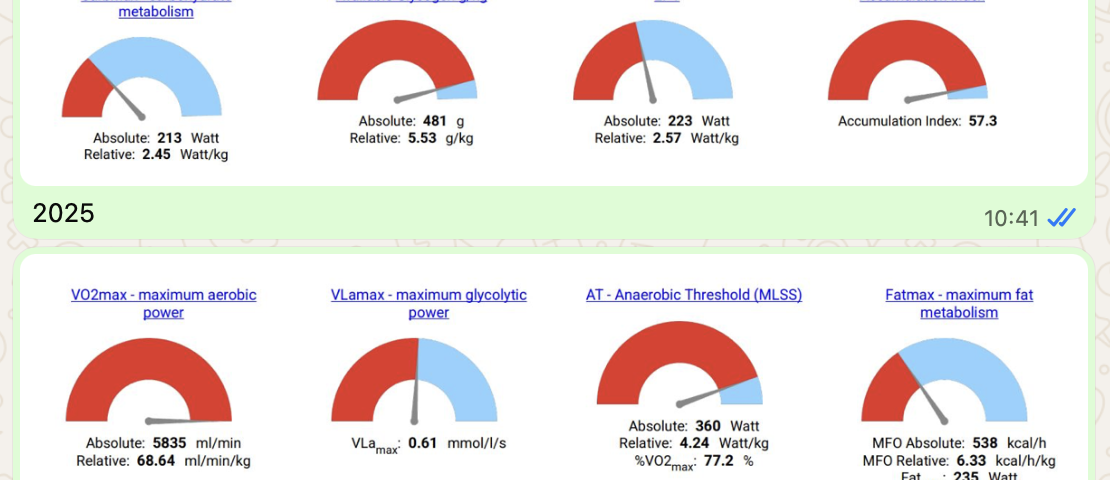
By Arek Kogut, UCI-certified cycling coach, founder of Way2Champ
Every week someone on a call asks me some version of the same question. “I’m at 300 watts. Can I get to 330 by next season?”
My honest answer is that it depends much less on me than on you. Your history, your hours, your sleep and, most of all, what is actually limiting your threshold. Thirty watts on 300 is a 10% gain. For some riders that is a normal six months. For others it is a two-year project, and a coach who promises it before seeing your data is guessing.
In this article I’ll show you how I decide which group you are in, why most riders over 40 stop improving, and what the numbers look like in real riders I coach. All the data comes from lactate tests and INSCYD metabolic profiles, not from estimates.
Who can realistically add 30 watts in 6 months
From what I see in my athletes, +30 W in 6 months is realistic when at least one of these is true.
- Your zones come from a 20-minute test, a ramp test or a Garmin estimate, and they have never been checked with a lactate test.
- You train 6 to 12 hours a week, but most of it is “medium hard”. Sweet spot on Tuesday, a Zwift race on Thursday, the group ride on Saturday.
- Your FTP has been flat for 1 to 3 years, even though you train consistently.
- Nobody has ever measured your VO2max and VLamax.
It is much harder, and I’ll tell you so on a call, when you already train 12+ hours a week with tested zones and a coach who retests you, when you have less than 5 to 6 hours a week, or when sleep and stress leave nothing for adaptation.
If you train 6 to 12 hours a week and your FTP hasn’t moved in a year, book a free Cycling Breakthrough Call. We’ll look at your data, and I’ll tell you honestly whether +30 W in 6 months is realistic for you.
Why your FTP stopped moving
FTP is a result. It tells you what you did, not why you couldn’t do more.
Your threshold is produced by two engines that work against each other. The aerobic engine (VO2max) uses oxygen, burns fat and clears lactate. The glycolytic engine (VLamax) burns sugar fast and produces lactate, which gives you the punch for an attack or a sprint. Your threshold is the point where the aerobic engine can still clear what the glycolytic engine produces.
The same FTP can be built in completely different ways. Here are three riders I tested in the same month, all at about 3.0 W/kg.
| Lactate test | Rider 1 | Rider 2 | Rider 3 |
|---|---|---|---|
| Threshold | 2.9 W/kg | 3.0 W/kg | 3.0 W/kg |
| VO2max (ml/min/kg) | 44 | 48 | 49 |
| VLamax (mmol/l/s) | 0.30 | 0.43 | 0.47 |
| Threshold as % of VO2max | 83% | 78% | 76% |
Rider 1 already rides at 83% of his aerobic ceiling. Nothing moves for him until the ceiling moves. Rider 3 has a bigger ceiling but uses only 76% of it, because his glycolytic engine is much louder. Same FTP on paper, opposite training in reality. Give them the same plan and at least one of them trains the wrong thing, hard, for months.
After 40 this matters even more. Research on masters athletes (Tanaka and Seals, Journal of Physiology, 2008) shows VO2max drops by roughly 10% per decade in the average adult, and less in people who keep training well. Recovery also gets slower. So the aerobic engine is the one you have to protect, and you can’t afford to waste months on the wrong stimulus.
The number in your app is probably too high
This is the most common limiter I find, and it is the easiest to fix. Here are three recent riders, with the FTP they were training on compared with what the lactate test showed.
| Rider | FTP in the app | Lactate test threshold | Difference |
|---|---|---|---|
| Rider, 49 | 260 W | 214 W | 46 W lower |
| Rider, 47 | 340–350 W | 309 W | about 36 W lower |
| Rider 3 | 250 W | 239 W | 11 W lower |
With a 46 W error, every “threshold” interval is really a VO2max interval, and every “endurance” ride is tempo. The rider ends every week tired, and neither engine gets a clear signal to change. Another season like that and he starts to believe it is his age. In most riders I test, age is not the reason.
What the numbers look like in real riders
I’ll be precise about time here, because this is where most coaching marketing gets slippery.
Primo, 42 · 12 months
Primo came from the gym, has been riding for 4 years and trains around 10 hours a week. Two INSCYD tests, one year apart.
| Primo, 42 | 2025 | 2026 | Change |
|---|---|---|---|
| Threshold (MLSS) | 309 W (3.55 W/kg) | 360 W (4.24 W/kg) | +51 W |
| VO2max | 59.0 ml/min/kg | 68.6 ml/min/kg | +9.6 |
| LT1 | 223 W | 259 W | +36 W |
| FatMax | 200 W | 235 W | +35 W |
| Available glycogen | 481 g | 542 g | +61 g |
| VLamax | 0.60 | 0.61 | no change |
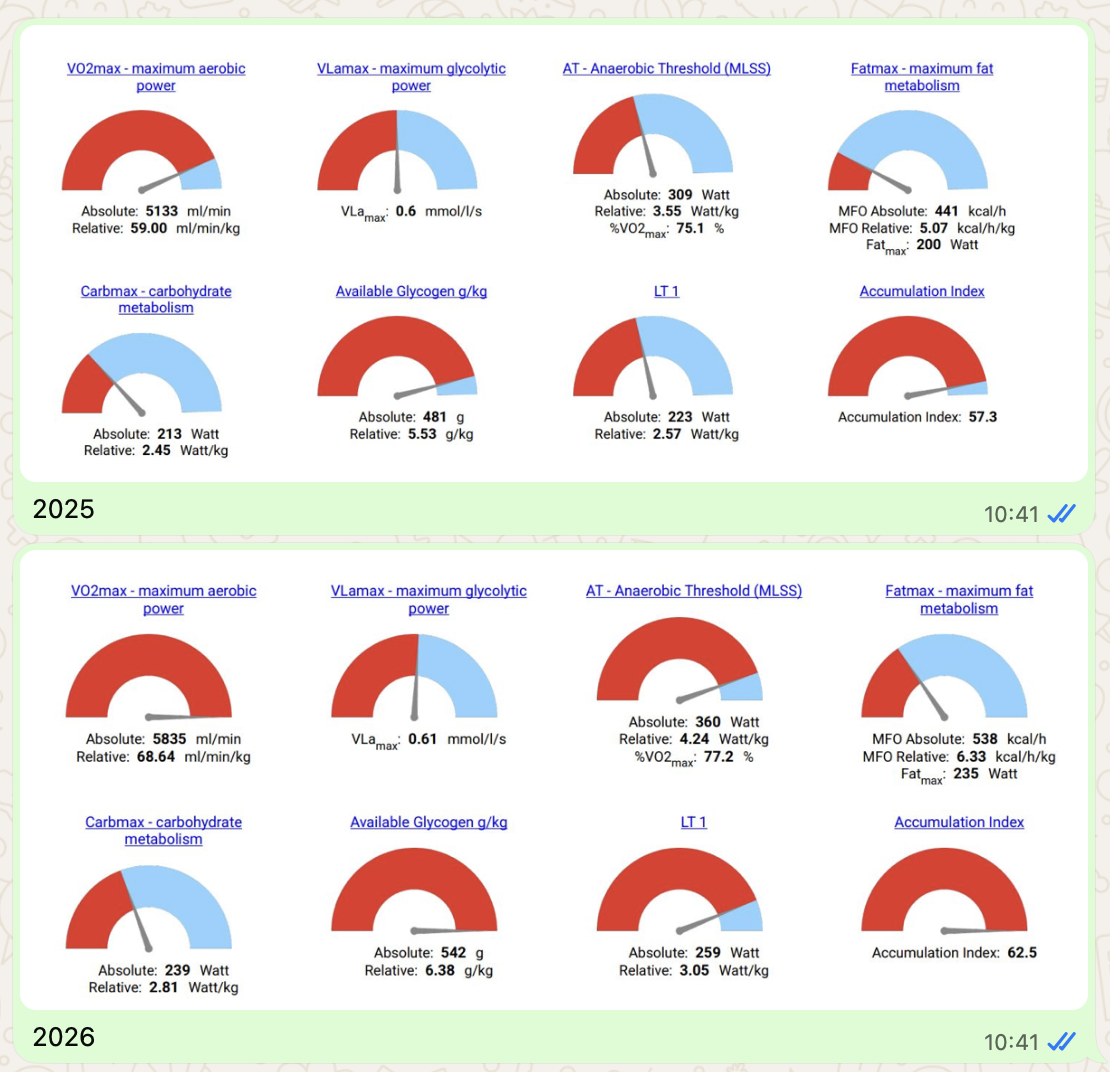
His glycolytic engine stayed exactly where it was. The whole gain came from the aerobic side, and his threshold now sits at a higher share of a much bigger VO2max (77.2% against 75.1%). Without the test we would not have known where to look. This took 12 months, not 6.
Dariusz, 47 · one season
+49 W FTP. On his regular hilly loop he went from 26 km/h to 34 km/h, won 4 mountain races, moved from mid-pack to the top 3 at UCI Gran Fondo events and finished 8th at the UCI Gran Fondo World Championships, on the same training hours.
Max · 8 months
Started at 260–270 W, reached over 320 W, close to 4.6 W/kg, and finished top 30 at Haute Route Alps.
Peter, 62 · one season
+43 W. Peter is from the US and had tried other coaches and online programs before. He is the oldest rider on this list, and his limiter was not his age.
Shorter blocks, inside the 6-month window
From INSCYD files and public Google reviews, +35 W in 8 weeks, +27 W in 8 weeks in a rider over 50, and +20 W in 11 weeks while losing 5 kg.
What the timeline usually looks like. The first 6 to 8 weeks often look boring on paper. We correct the zones, the sleep, the fueling and the base, and sometimes the first test shows a threshold lower than the app said. The watts usually come after that. Riders with a big zone error see fast early gains, while riders who are already well trained see slower, steadier ones.
What metabolic testing does, and what it doesn’t
A test doesn’t make you faster. Training, consistency and recovery do. What the test does is make sure every one of your 6 to 12 hours a week goes after your real limiter, and a retest every 8 to 10 weeks shows whether it is working, instead of you hoping it is.
A one-time lab test rarely changes much. Most riders get a PDF with zones and then go back to the same training. The value comes when someone builds every week on the result and measures again.
How the 6 months work at Way2Champ
- Weeks 1 to 2. A lactate testing kit comes to your home. You test on your own bike, indoors or outdoors, and I guide you through it. We build your INSCYD profile (VO2max, VLamax, LT1, threshold, FatMax) and I go through your training history, sleep, HRV and blood work.
- Weeks 2 to 24. Your training in TrainingPeaks, bike and strength, updated every week and the same day your work or travel changes.
- Every day. I look at every ride and comment on it. You reach me on WhatsApp on business days. A sports nutritionist works on your fueling and weight.
- Weeks 8–10, 16–18 and 24. Retests, so we see the change in numbers, and a pacing and fueling plan before your main event.
The guarantee
At least +30 W on your threshold in 6 months, measured with the same lactate test at the start and the end, or your money back. The one condition is that you complete at least 80% of the prescribed sessions.
I can put that in writing because I only take riders I’m confident I can help, and I take a maximum of 4 new athletes a month. If I look at your data and 30 W isn’t realistic, I’ll tell you on the call.
Questions I hear often
“I’m 55. Can I really add 30 watts?” In most cases, yes. At 50 or 55 the usual limiters are wrong zones and poor recovery, and both can be fixed. Peter added 43 W at 62.
“My weeks are chaos.” Most of my athletes live like that. One is a firefighter on 24-hour shifts. That is why the plan changes the same day and why the bar is 80% of sessions, not 100.
“You’re in Europe, I’m in the US.” World Tour riders are coached remotely most of the year too. I see every ride, your sleep and your HRV, and I usually go through your ride while you sleep.
“Is the lactate test complicated?” No. A drop of blood from the finger or ear a few times during a 60 to 90 minute ride, on your own bike. I guide you through the first one.
About the author
Arek Kogut raced for 10 years in Poland, Italy and Spain, and in 2014 completed the UCI Coaching Diploma at the World Cycling Centre in Switzerland. He coached Katarzyna Niewiadoma for two years early in her career, years before her 2024 Tour de France Femmes win. Since then he and the Way2Champ team have coached more than 3,000 cyclists, today mostly masters riders aged 40 to 60. He is the author of the Polish cycling book Od rowerzysty do kolarza. Way2Champ holds a 5.0 rating from 76 Google reviews (October 2026).
Find out what is limiting you
If you train 6 to 12 hours a week and your FTP hasn’t moved in a year, book a free Cycling Breakthrough Call. We’ll look at your data, and I’ll tell you honestly whether +30 W in 6 months is realistic for you.