How to shed excess weight the simple way through cycling?
14 April 2026
Low-Cadence Sprints vs. Grinder Intervals: Which One Actually Builds Power?
15 May 2026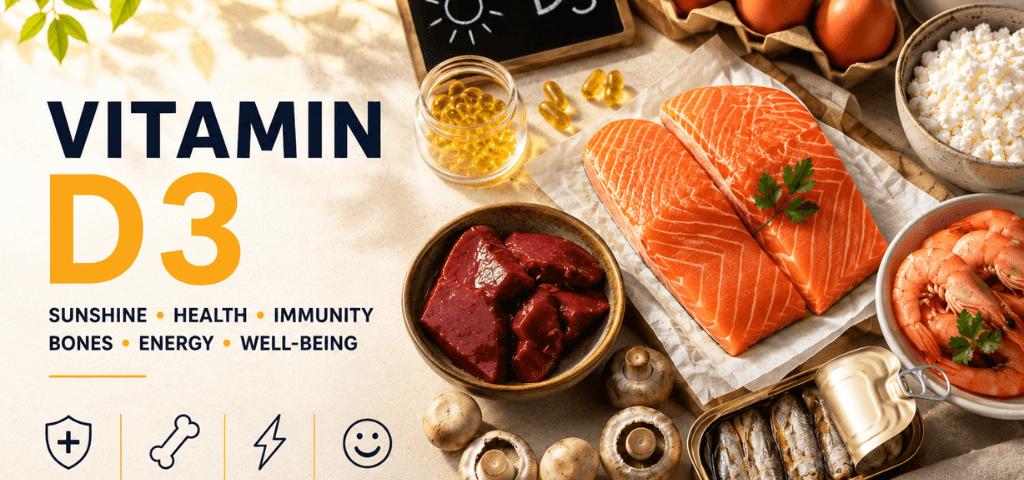
Key takeaways
- Vitamin D is a prohormone produced in the skin under UVB radiation and affects skeletal muscle, bone health, immunity, and cardiovascular function.
- Vitamin D3, or cholecalciferol, is produced in the skin and comes from animal sources, while vitamin D2 comes mainly from plants and fungi.
- Vitamin D status is assessed through a blood test measuring serum 25-hydroxyvitamin D, or 25(OH)D.
- The article argues that cyclists cannot assume their vitamin D level is adequate simply because they spend many hours training outdoors.
- Early-morning and evening rides produce little vitamin D because the sun is too low for sufficient UVB radiation to reach the skin.
- Cycling clothing exposes only a small percentage of the body, while SPF 30 sunscreen can substantially reduce vitamin D synthesis.
- Cyclists living north of the 40th parallel may experience a seasonal “vitamin D winter” lasting approximately five or six months, during which meaningful skin synthesis is limited or absent.
- The article identifies New York, Boston, Chicago, Seattle, and Minneapolis as locations with particularly restricted winter UVB exposure, while year-round synthesis is more feasible in southern cities such as Miami, Phoenix, and Los Angeles.
- Low vitamin D may affect muscle protein synthesis, recovery, type II muscle fibers, contraction speed, and short-duration power.
- Vitamin D deficiency may also increase concern about bone health because cycling is a low-impact sport and cyclists can have lower bone mineral density than the general population.
- The article connects inadequate vitamin D status with a greater risk of respiratory infections during periods of high training load.
- Supplementation appears most likely to improve performance in athletes who begin with a deficiency; raising already adequate levels further is not presented as producing additional benefits.
- The article cites studies in which vitamin D3 supplementation improved VO2max, anaerobic performance, sprint performance, vertical jump, or muscle strength, although the size of the effect varied between studies.
- The recommended first step is a serum 25(OH)D blood test rather than beginning supplementation based only on symptoms or assumptions.
- Testing twice per year can show seasonal changes: once in late September or early October after summer and again in late February or early March near the annual minimum.
- The article uses 30 ng/mL, or 75 nmol/L, as a practical minimum for athletes and describes 30–50 ng/mL, or 75–125 nmol/L, as the target range commonly used in sports performance practice.
- According to the article, cyclists with levels above 30 ng/mL may use 1,000–2,000 IU of vitamin D3 daily during autumn and winter.
- For levels below 20 ng/mL, the article proposes 4,000–5,000 IU daily for six to eight weeks, followed by another blood test and a move to a maintenance dose.
- Severe deficiency below 10 ng/mL should be managed with a physician, while doses above the standard tolerable upper intake should be medically monitored.
- Vitamin D3 should be taken with a meal containing fat because it is fat-soluble and absorption is lower when it is taken without food.
- Foods such as wild salmon, mackerel, sardines, tuna, cod liver oil, fortified milk, and egg yolks provide vitamin D, but the article argues that diet alone is usually insufficient during a northern winter.
- Vitamin K2, particularly the MK-7 form, is presented as a possible addition during prolonged higher-dose vitamin D3 supplementation because it participates in calcium metabolism, although the article notes that sports-specific evidence is limited.
- Vitamin D toxicity is associated mainly with prolonged excessive supplementation and elevated blood calcium; the article states that ordinary doses of 1,000–4,000 IU per day are generally considered safe for healthy adults.
- The practical action plan is to test 25(OH)D, select the vitamin D3 dose according to the result, take it with a fatty meal, retest after correction, and monitor seasonal changes.
- The article does not replace medical consultation and recommends professional guidance before higher-dose supplementation, particularly for people taking medication or living with chronic health conditions.
If you ride 10-15 hours a week, you probably assume your vitamin D is fine. Sun, fresh air, hours in the saddle. Under American conditions, especially north of the 40th parallel, that assumption usually falls apart. The combination of pre-work rides, sunscreen, long sleeves, and your latitude means most cyclists produce surprisingly little vitamin D from the sun. Some of you produce practically none, no matter how many miles you log.
Before I get to the numbers, one thing worth remembering: if you haven’t had your 25(OH)D blood level tested in the last 12 months, you don’t know where you stand. “I feel fine” is not enough to assess the status of a hormone whose deficiency develops over months before it gives clear symptoms.
What Vitamin D Actually Is?
Vitamin D isn’t a true vitamin. It’s a prohormone the skin synthesizes under UVB radiation. It acts through the VDR receptor present in virtually every tissue in the body, including skeletal muscle, bone, the immune system, and the cardiovascular system.
In practice, we have two forms: D3 (cholecalciferol, from animal sources and produced in skin) and D2 (ergocalciferol, from plants and fungi). Both are inactive until the liver converts them into 25-hydroxyvitamin D, or 25(OH)D. This is the form measured in blood tests and the one that determines your status. The kidneys then convert 25(OH)D into the hormonally active 1,25(OH)2D.
One detail matters in practice: D3 raises 25(OH)D about 10x more effectively than D2. Your skin only produces D3. Supplement with D3, never D2.
Why It Matters for a Cyclist?
VDR receptors are present in skeletal muscle, which is why deficiency hits directly at what concerns you on the bike. Active vitamin D supports muscle protein synthesis, recovery, and has a particular effect on type II fibers, the fast-twitch fibers responsible for sprints, climbs, and short-duration power. Under deficiency, these fibers atrophy, contraction velocity drops, and peak power decreases. If your 5-second and 1-minute power numbers in WKO5 or TrainingPeaks have been slowly drifting down despite consistent training, low vitamin D is one of the candidates worth ruling out.
The second issue is bones. Low vitamin D forces the body to pull calcium from bone, which in cyclists who already have lower bone mineral density than the general population (cycling is a low-impact sport) increases the risk of stress fractures. Research on young athletes shows a clear connection: athletes with bone injuries had significantly lower 25(OH)D than those without.
The third issue is immunity. Vitamin D has immunomodulatory and anti-inflammatory effects. Cyclists with low levels get upper respiratory infections more often, especially during periods of increased training load. Anyone who built up to a January base block in Boulder or Boston and then spent 10 days fighting sinusitis knows what I’m talking about.
US Latitude. This Is Where the Real Problem Starts!
Vitamin D synthesis requires UVB in the narrow 290-315 nm range. This radiation reaches the skin in sufficient quantities only when the UV index is at least 2, which corresponds to the sun sitting 30-45° above the horizon. Below that angle, the atmosphere absorbs most UVB before it touches your skin.
The 40th parallel runs through Philadelphia, Columbus, Indianapolis, Denver, and just north of Sacramento. Everything north of that line has a real “vitamin D winter” each year where the UV index simply doesn’t rise high enough at midday for meaningful synthesis, regardless of how clear the sky is.
Specifically:
- New York, Boston, Chicago (41-42°N): vitamin D winter from late October to mid-March. Real UVB production window April-September, peak intensity May-August between roughly 11:00 and 15:00
- Seattle, Minneapolis (45-47°N): even longer winter window, November through March essentially zero, weak production at the shoulders
- Denver (39.7°N): borderline, but altitude helps — UV intensity is meaningfully higher at 5,280 ft, partially compensating
- Los Angeles, Phoenix, Atlanta, Miami (25-34°N): year-round synthesis is technically possible at midday, but most people there are inside during the relevant hours, and sunscreen is more aggressively used
The 2025 global meta-analysis covering over 2.3 million people found 47% of healthy adults worldwide had 25(OH)D below 50 nmol/L (20 ng/mL). The US data sits in line with this. In NHANES surveys, roughly 30-40% of American adults are deficient or insufficient depending on the threshold used, and the rate climbs significantly in winter and in northern states.
Pre-Work Rides – the American Paradox
Most of the cyclists I work with on the US side are professionals and executives. They train either before work (5:30-7:30 AM) or in the evening after 5 PM. Structurally, this creates a problem.
At 6:00 AM in June, even with a cloudless sky over Manhattan or Chicago, the UV index is near zero. The sun is too low, the atmosphere filters most of the UVB. A rider who heads out at 5:30 and returns at 8:00 spends 2.5 hours on the bike without producing vitamin D. Same in the evening — after 17:00 in August, after 16:00 in September, UV drops below the synthesis threshold quickly.
The paradox: a cyclist racking up 15 hours a week at dawn may produce less vitamin D than a sedentary person eating lunch in Central Park at noon.
Add the specifics of cycling kit. Bibs, long sleeves on cool mornings, gloves, helmet. In practice, only your face, neck, and maybe a strip of forearm are exposed — 5-10% of body surface area. Standard estimates of D production assume 25%.
Add sunscreen on top (which you should use for your skin), and SPF 30 reduces vitamin D synthesis by approximately 95%.
The conclusion is uncomfortable but clear: most American cyclists who are “always outside” don’t produce meaningful vitamin D from riding. If you live north of the 40th parallel, don’t supplement, and don’t deliberately get midday sun on bare skin a few times a week in summer, you are almost certainly deficient or insufficient for at least half the year.
What the Research Shows?
The literature on vitamin D supplementation in athletes is positive, with an important caveat: the largest effects show up in athletes who start deficient. Pushing someone already saturated to higher levels doesn’t bring additional performance gains.
Specific data worth knowing:
- 12 weeks of 2000 IU D3 daily in active men improved VO2max and anaerobic power versus placebo
- 8 weeks of 5000 IU daily in deficient British athletes raised 25(OH)D from 53 to 103 nmol/L (21 to 41 ng/mL) and improved 10-meter sprint times and vertical jump
- A meta-analysis of 6 trials showed muscle strength improvements of 1-19% after D3 supplementation. Vitamin D2 produced no effect in any trial
Another finding worth knowing: the 2025 VitaDEx study showed that 10 weeks of regular indoor aerobic exercise over winter maintained levels of the active 1,25(OH)2D3 form, while in the sedentary group they dropped 15%. The likely mechanism: training mobilizes vitamin D stored in adipose tissue. This doesn’t mean training alone protects you from deficiency if you enter winter low. But it’s an argument for keeping the structured indoor work going through the months you’re not producing D from the sun.
The Most Important Step: Get Tested
This is the point I push on every athlete I work with. Supplementing without testing is guessing. Two cyclists on the same training schedule and same diet can have very different 25(OH)D levels, driven by genetics, skin pigmentation, body composition, and where they live.
The standard test is serum 25(OH)D. In the US you have two routes:
- Through your doctor, sent to LabCorp or Quest Diagnostics. Usually covered by insurance if your physician orders it for a clinical reason. Typical cash price 40-80 USD.
- Direct-to-consumer through services like Everlywell, LetsGetChecked, InsideTracker, or Ulta Lab Tests. No physician visit needed. Cost typically 50-100 USD. Results in days.
Optimal strategy: test twice a year.
- Late September / early October — your annual peak after summer
- Late February / early March — your annual minimum before the new season
These two data points show how much you build in summer and how much you lose in winter. Only then can you dial in supplementation consciously.
There’s some debate about the target range. The official “sufficiency” threshold is 20 ng/mL (50 nmol/L), but among coaches and sports physicians the consensus is that this is too low for an athlete. Most of the sports performance literature uses 30 ng/mL (75 nmol/L) as a minimum, with the optimal range being 30-50 ng/mL (75-125 nmol/L). That’s the level worth aiming for.
How to Supplement? Specifically
Three principles cover most decisions:
Form
D3 only (cholecalciferol). Check the label. On the US market this is the default — Thorne D-1000 or D-5000, NOW Foods D3, Nordic Naturals Vitamin D3, Sports Research D3, Pure Encapsulations, Bronson. All forms (softgel, capsule, drops, sublingual) work; the dose matters more than the format.
Dose
Depends on your test result. General rule: 1000 IU daily raises 25(OH)D by approximately 5 ng/mL (12-13 nmol/L), but that’s an average. Individual response varies. In practice:
- Preventively, if your test shows saturation (above 30 ng/mL): 1000-2000 IU daily during the fall-winter period (October through March). Reduce or pause in summer if you’re regularly exposing skin to midday sun.
- Deficiency (below 20 ng/mL): corrective dose of 4000-5000 IU daily for 6-8 weeks, then retest and move to maintenance. With severe deficiency (below 10 ng/mL) consult a physician — sometimes loading-dose protocols (50,000 IU once weekly under supervision) are used.
The IOM upper tolerable intake for healthy adults is 4000 IU daily without medical supervision. Higher doses should be monitored.
Absorption
Always with a meal containing fat. Vitamin D is fat-soluble. Taking it on an empty stomach or with coffee significantly reduces absorption. Take it with breakfast — eggs, avocado, peanut butter, whole-milk yogurt — not in the evening, since D has some effect on circadian rhythm.
Diet – Helpful but Insufficient
US food sources of vitamin D, in descending order of impact per serving:
- Wild Alaska salmon (sockeye, king): 600-1000 IU / 100 g (3.5 oz)
- Farmed Atlantic salmon: 100-250 IU / 100 g
- Atlantic mackerel: 350-650 IU / 100 g
- Canned sardines: 250-300 IU / 100 g
- Canned tuna (light, in oil): 150-250 IU / 100 g
- Cod liver oil (Carlson, Nordic Naturals — 1 teaspoon): roughly 400-1000 IU depending on brand
- Fortified milk: 100-120 IU per 8 oz glass (the US has fortified dairy since the 1930s, which is the main reason American children rarely get rickets despite low natural intake)
- Egg yolk: 40-50 IU each
- Fortified breakfast cereals: variable, typically 40-100 IU per serving
The problem: even with two servings of salmon per week, eggs daily, and milk in your coffee, dietary intake alone won’t maintain saturation through a northern winter. Realistic dietary intake for an American adult averages 150-300 IU daily. An athlete’s actual requirement to maintain status is 2000+ IU.
Cod liver oil is historically and biologically sensible if you tolerate it. One teaspoon of a standard product is roughly equivalent to a 1000 IU capsule, plus you get omega-3s and vitamin A.
Vitamin K2, the Partner for D3
Vitamin K2, particularly the MK-7 form, works alongside vitamin D in calcium metabolism. D3 increases calcium absorption from the gut and raises blood calcium. K2 activates proteins (osteocalcin, MGP) that direct that calcium into bone and away from soft tissues and arteries.
In practice: if you supplement D3 at higher doses for an extended period and your diet is low in K2 (few fermented foods, not many egg yolks, few aged cheeses), it’s worth adding K2 MK-7 at 90-200 mcg daily. Plenty of combination products exist on the US market: Thorne Vitamin D/K2 Liquid, Sports Research D3+K2, Live Conscious K2+D3, Pure Encapsulations Vitamin D3 with K2.
US dietary sources of K2: natto (rare outside Japanese groceries), aged hard cheeses (cheddar, gouda, parmesan), egg yolks from pasture-raised birds, grass-fed butter, certain fermented vegetables. This isn’t an area with strong clinical evidence in sports specifically, but a reasonable hedge if you’re going to supplement D3 long-term.
Risks and Toxicity
Vitamin D, being fat-soluble, accumulates. Toxicity (hypervitaminosis D) presents with elevated blood calcium — nausea, weakness, excessive thirst, in severe cases kidney damage. This typically occurs with long-term intake above 10,000 IU daily. Standard supplemental doses of 1000-4000 IU are safe.
Sun-driven toxicity is impossible — the skin has a self-regulating mechanism. Excess previtamin D3 is broken down by the same light that produces it.
Action Plan: What Actually Needs to Be Done?
- Get a 25(OH)D test in the next 2 weeks. Through your doctor, or direct-to-consumer through Everlywell, LetsGetChecked, or InsideTracker. Cost 40-100 USD. If it’s currently late winter or spring and you haven’t been supplementing, this is the right moment — you’ll catch your annual minimum.
- Match the dose to your result. Saturation (above 30 ng/mL): 1000-2000 IU daily in the fall-winter season. Deficiency (below 20 ng/mL): corrective dose 4000-5000 IU for 6-8 weeks and retest.
- Supplement D3, not D2. Check the label.
- Take with a fatty meal, ideally morning or midday.
- Run a second test late September / early October to see where you ended up after summer and whether you need to adjust the dose for winter.
- In summer, if practical, get 20-30 minutes of midday sun every few days with exposed forearms and legs, no sunscreen. This won’t replace winter supplementation, but it has additional benefits (UVA exposure, nitric oxide release, lipid profile effects) that a pill doesn’t deliver.
Summary – Vitamin D for Cyclists
The assumption “I ride outside, so I have enough vitamin D” is, for the typical American cyclist living north of Denver’s latitude, just wrong. The combination of latitude, pre-work training hours, full kit, and sunscreen makes actual D production close to zero for 5-6 months a year, and frequently insufficient even outside that window.
The good news: this is one of the easier nutritional problems to solve in sport. A test costs less than a tubeless tire, a year’s supply of quality D3 costs less than a single energy gel per ride, and the difference in muscle function, immune resilience, and bone integrity is real and measurable.
If you did nothing about this last winter, you still have time to catch up before your A-race this season. Get tested and act on the result.
This article is based on material by Dr. Jeff Rothschild (Knowledgeiswatt, May 2026), adapted with US-specific climatic, dietary, and practical context. The text does not replace medical consultation. Before starting supplementation at higher doses, consult a physician, particularly if you take other medications or have chronic conditions.
Arek Kogut, UCI-Certified Coach, Way2Champ
- Dunlop E, Pham NM, Hoang DV, et al. A systematic review and meta-analysis of circulating 25-hydroxyvitamin D concentration and vitamin D status worldwide. J Public Health. 2025. doi:10.1093/pubmed/fdaf080
- Close GL, Russell J, Cobley JN, et al. Assessment of vitamin D concentration in non-supplemented professional athletes and healthy adults during the winter months in the UK: implications for skeletal muscle function. J Sports Sci. 2013;31(4):344–353.
- Owens DJ, Fraser WD, Close GL. Vitamin D and the athlete: emerging insights. Eur J Sport Sci. 2014;15(1):73–84.
- Kift RC, Webb AR. Globally estimated UVB exposure times required to maintain sufficiency in vitamin D levels. Nutrients. 2024;16(10):1489.
- Gruber-Bzura BM. Vitamin D — is the sun enough for us? Nutr Metab. 2025;22:70.
- Perkin OJ, Davies SE, Hewison M, et al. Exercise without weight loss prevents seasonal decline in vitamin D metabolites: the VitaDEx randomized controlled trial. Adv Sci. 2025. doi:10.1002/advs.202416312
- Ramezani Ahmadi A, Mohammadshahi M, Alizadeh A, Ahmadi Angali K, Jahanshahi A. Effects of vitamin D3 supplementation for 12 weeks on serum levels of anabolic hormones, anaerobic power, and aerobic performance in active male subjects. Eur J Sport Sci. 2020;20(10):1355–1367.
- Chiang CM, Ismaeel A, Griffis RB, Weems S. Effects of vitamin D supplementation on muscle strength in athletes: a systematic review. J Strength Cond Res. 2017;31(2):566–574.
- Ksiazek A, Zagrodna A, Slowinska-Lisowska M. Vitamin D, skeletal muscle function and athletic performance in athletes — a narrative review. Nutrients. 2019;11(8):1800.
- Senisik S, Koyagasioglu O, Denerel N. Vitamin D levels on sports injuries in outdoor and indoor athletes: a cross-sectional study. Phys Sportsmed. 2022;50(2):164–170.
- Owens DJ, Kasper AM, Close GL. Current practice in the measurement and management of vitamin D status in elite sport and parasport. Eur J Sport Sci. 2025;25:e12305.
- Patwardhan VG, Mughal ZM, Padidela R, et al. Randomized control trial assessing impact of increased sunlight exposure versus vitamin D supplementation on lipid profile in Indian vitamin D deficient men. Indian J Endocrinol Metab. 2017;21(3):393–398.
- Stevenson AC, Clemens T, Pairo-Castineira E, et al. Higher ultraviolet light exposure is associated with lower mortality: an analysis of data from the UK Biobank cohort study. Health Place. 2024;89:103328.
- Newton-Bishop JA, Beswick S, Randerson-Moor J, et al. Serum 25-hydroxyvitamin D3 levels are associated with Breslow thickness at presentation and survival from melanoma. J Clin Oncol. 2009;27(32):5439–544
Thinking about cycling training? If you want to take your riding to the next level, we have a great option for you:
- Individual coaching – work one-on-one with an experienced coach who will continuously adjust your training load to your needs and support your development as a cyclist.