Vitamin D for Cyclists: why American Riders Are Massively Deficient Despite All Those Hours on the Bike
15 May 2026
VO2max in Cycling: Why harder doesn’t always mean better
28 May 2026
Key takeaways
- Low-cadence sprints and longer grinder intervals are often grouped under “torque training,” but they create very different physiological stimuli.
- The article describes a 10-week randomized study involving 46 well-trained male cyclists with an average VO2max of 63 ml/kg/min.
- The cyclists completed the same overall training volume and intensity distribution, while only the type of torque training differed between groups.
- The high-intensity torque group performed two weekly sessions of maximal 10-second seated sprints from a standing start on a 6% climb at approximately 40 rpm.
- Each high-intensity session consisted of 5 sets of 7 sprints, with four minutes of recovery between efforts.
- The medium-intensity torque group performed two weekly sessions of 5 × 4 minutes at 50 rpm and 85–90% of FTP, with two minutes of passive recovery.
- After 10 weeks, the high-intensity torque group increased power at VO2max by 4.9%, compared with 1.0% in the medium-intensity group and 1.3% in the control group.
- Power at the second ventilatory threshold increased by 3.2% in the high-intensity group, compared with 1.4% in the medium-intensity group and a 0.6% decrease in the control group.
- Power at the first ventilatory threshold also increased by 3.2% in the high-intensity group, compared with 1.7% in the medium-intensity group and a 0.6% decrease in the control group.
- Wingate peak power improved by 5.8% in the high-intensity group, while the medium-intensity group improved by 1.3% and the control group declined by 2.3%.
- Quadriceps cross-sectional area increased by 3.5% after high-intensity torque training, compared with 0.7% after medium-intensity torque work.
- Cycling efficiency did not improve in any group, so the study did not support the claim that low-cadence torque training automatically makes pedalling more efficient.
- The results suggest that short maximal low-cadence sprints provide a stronger neuromuscular and structural stimulus than longer sweet-spot grinder intervals.
- Medium-intensity grinder intervals are not necessarily useless, but the article presents them as more suitable for technique work, smooth pedalling under load, or preparation for gear-restricted events than for directly increasing FTP.
- A practical high-intensity torque session begins with a 20–30-minute warm-up, followed by 5 sets of 7 maximal 10-second seated sprints in a large gear at roughly 40 rpm.
- The recommended recovery is four minutes of easy spinning between sprints and five to six minutes between sets, making the total session approximately 75 minutes.
- These sessions should be performed twice per week on fresh legs because quality and peak-force production matter more than simply completing every repetition.
- The productive part of the session is considered over when peak power falls by more than approximately 10–15%.
- For cyclists seeking more usable power at VO2max, threshold, aerobic threshold, and sprint intensity, the article concludes that short maximal torque sprints are more effective than 4-minute low-cadence sweet-spot intervals.
If you ride seriously — whether you race masters crits in California, line up for Unbound, or chase KOMs on Old La Honda — you have almost certainly done some form of torque training. Big gear, low cadence, climbing. Some coaches swear by 4-minute grinders at 50 rpm in tempo. Others prescribe short, explosive low-rpm sprints out of the saddle. They get called the same thing, but physiologically they are very different animals.
A study published in May 2026 in the Scandinavian Journal of Medicine & Science in Sports finally compared these two approaches head to head in the same group of trained cyclists. The results are clear enough that they should change how a lot of riders structure their work this season.
The Study – Briefly
Researchers from Universidad Europea de Madrid (de Pablos and colleagues) took 46 well-trained male cyclists — average VO2max 63 ml/kg/min, range 56 to 78 — and split them into three groups for 10 weeks. All groups did the same overall training volume and zone distribution. The only thing that differed was the torque work.
HTRQ group (high-intensity torque): two sessions per week. Each session was 5 sets of 7 maximal sprints, performed seated, from a standing start, uphill on a 6% grade, in a very big gear. Cadence sat around 40 rpm. Each effort lasted about 10 seconds. Force on the pedal was approximately 70% of maximal dynamic force. Four minutes of recovery between sprints.
MTRQ group (medium-intensity torque): two sessions per week of 5×4 minutes at 50 rpm, intensity at 85–90% FTP — basically high tempo / sweet spot in a grinder gear. Force on the pedal was about 35% of maximal dynamic force. Two minutes of passive recovery.
Control group: same endurance work, no torque sessions.
What Happened?
Only the high-intensity torque group improved meaningfully. And it was not subtle.
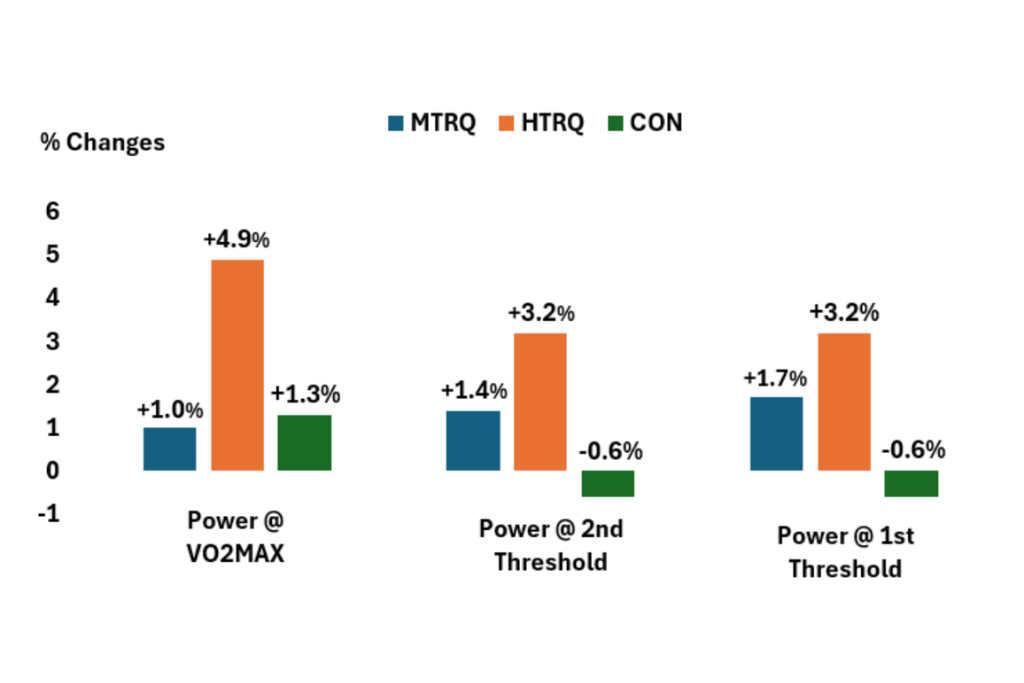
Power at VO2max: HTRQ +4.9% (5.9 to 6.2 W/kg). MTRQ +1.0%. Control +1.3%.
Power at the second ventilatory threshold (think upper FTP / threshold territory): HTRQ +3.2%. MTRQ +1.4%. Control −0.6%.
Power at the first ventilatory threshold (aerobic threshold, LT1): HTRQ +3.2%. MTRQ +1.7%. Control −0.6%.
Wingate peak power (30-second all-out test): HTRQ +5.8%. MTRQ +1.3%. Control −2.3%.
Quadriceps cross-sectional area: HTRQ +3.5%. MTRQ +0.7%. Control −3.0%.
Cycling efficiency — how much of your metabolic energy actually turns into watts at the crank — did not change in any group. So if you have read that torque work “makes you more efficient,” this study did not find that. What it did find is something more useful: real gains in usable power, both at threshold and at VO2max, plus measurable muscle growth in the quads.
Why This Matters for the Average Serious Rider?
Here is the uncomfortable part. Most riders I see — including a lot of well-coached masters racers — are doing the medium-intensity version when they think they are doing torque work. Picture the typical ride up Mount Tamalpais or Lookout Mountain in Boulder: you stay in the 53 in the back, cadence drops to 60–65, watts sit around 90% of FTP. That is textbook MTRQ. And the data here suggests that after 10 weeks of that, you get almost nothing beyond what normal riding would give you.
Now compare that to what the HTRQ group actually did. Ten seconds. Big gear. Standing-start, seated effort. Maximal. Then 4 full minutes of recovery before the next one. Seven of those per set, 5 sets. That is a fundamentally different physiological signal. Closer to a heavy strength session in the weight room than to a traditional cycling interval — which lines up with what we have known for years: heavy strength work improves cycling performance. This study suggests you can get a meaningful chunk of that benefit on the bike, if you do it correctly.
How to Apply It?
In the US, finding the right terrain is easy. Anything with a sustained 6–8% pitch works: a steep section of your favorite local climb, a parking-garage ramp, a short kicker out of a creek bed on a gravel route. You only need 10 seconds of clean grade. Even in flatter regions — Florida, the Midwest — bridge approaches and short overpass ramps will do.
The protocol that worked in the study, translated to a practical session: warm up thoroughly for at least 20–30 minutes with a couple of short openers. Then 5 sets of 7 sprints. Each sprint is performed from a near standstill, in a big gear (think 53/14 or similar — whatever drops your cadence to roughly 40 rpm at maximal effort), seated, full intent for 10 seconds. 4 minutes of easy spinning between sprints, 5–6 minutes between sets. Cool down. Total session: about 75 minutes.
Two sessions per week. Schedule them on fresh legs, not stacked on top of a hard workout the day before. This is a neuromuscular and structural stimulus, and quality matters more than completing every rep. If by set 4 your peak power is dropping more than 10–15%, the productive part of the session is over.
What About the Grinder Intervals?
Medium-intensity, low-cadence intervals at FTP are not useless, but the evidence is now stacking up that they are not where your threshold gains will come from. They have a place as a technique drill, as a way to reinforce smooth pedaling under load, or as preparation for a specific gear-restricted event. Just stop treating them as a primary tool for raising your FTP. The 10-second torque sprints did more for FTP-zone power than the 4-minute grinders did — by a significant margin — and they took less total time on the bike.
Summary – Low-Cadence Sprints vs. Grinder Intervals
For 10 weeks of focused work, short maximal uphill torque sprints out-performed 4-minute sweet-spot grinders on essentially every meaningful metric: VO2max power, threshold power, aerobic threshold power, sprint power, and quad size. If your goal is more usable wattage — for racing, for gran fondos, for gravel events — this is one of the cleanest direct comparisons we have. Use it.
Source
de Pablos R., Valenzuela P.L., Martínez-Cava A., et al. The Role of Pedaling Intensity During Torque Training in Cyclists: A Three-Arm Randomized Controlled Trial. Scandinavian Journal of Medicine & Science in Sports 36, no. 5 (2026): e70294.
Arek Kogut UCI Cycling Coach, founder of Way2Champ
Heat training works for everyone: beginners, intermediate cyclists, and professionals. Depending on your level, it can be adjusted to fit your capabilities.
Thinking about cycling training? If you want to take your riding to the next level, we have a great option for you:
- Individual coaching – work one-on-one with an experienced coach who will continuously adjust your training load to your needs and support your development as a cyclist.