Beer and cycling! – facts and myths
13 September 2017
Do you want to improve your cycling results? Find out these 5 easy principles
13 September 2017
Key takeaways
- The article analyzes a winning 5.5 km criterium race and shows that victory depended on a combination of physical preparation, tactics, positioning, technique, and psychological control.
- Maximum power is presented as especially important in criterium racing because frequent corners and accelerations create an interval-like effort pattern.
- Strength in both the legs and upper body is described as useful for repeated accelerations and aggressive riding.
- The psychological traits highlighted are persistence, willingness to fight from start to finish, confidence, and the ability to remain tactically calm under pressure.
- Knowing the competitors and riding the course before the race helped the rider choose better moments to attack and react.
- The article emphasizes “cold calculation”: even during a breakaway or decisive move, enthusiasm should be controlled so energy is not wasted unnecessarily.
- Heart rate was monitored during the race, but the rider noted that competition required substantially more power than normal training and made it easy to exceed usual limits.
- Before the finish, the rider deliberately used the descent to recover, adopted an aerodynamic position, and focused on smooth cornering to preserve speed.
- Cornering technique was a major tactical tool: choosing the optimal line, checking road-surface quality, braking late, and preparing a softer gear before the turn allowed faster acceleration on exit.
- In this race, riding close to the curbs on cobbled sections provided a smoother line and helped maintain speed.
- The rider avoided the back of the peloton because it increased the risk of crashes and made it easier to miss attacks from the front.
- His preferred position was near the front of the group while still staying behind one or two riders to save energy and remain protected from the wind.
- The article stresses that criterium races can become decisive immediately after the start, so riders cannot afford to be passive during the opening phase.
- The warm-up lasted about 30 minutes and included riding the course plus 3–4 strong sprint efforts.
- The winning race lasted 8:23, with normalized power of 373 W (5.5 W/kg), average power of 319 W (4.7 W/kg), average heart rate of 170 bpm, and maximum heart rate of 181 bpm.
- The first two laps were relatively hard and highly variable, at about 4.8–4.9 W/kg, with frequent accelerations and a Variability Index of 1.10–1.12.
- The final lap was more controlled, with lower relative power, conscious energy saving before the sprint, and a Variability Index of 1.00.
- The rider spent 3:10 without pedaling, equal to 38% of the race, which the article interprets as evidence of efficient group riding and deliberate energy conservation.
- Saving energy throughout the race allowed the rider to preserve enough capacity for the decisive final sprint, which reached approximately 12 W/kg for 15 seconds.
- The central lesson is that winning a short criterium is not only about producing the highest power; it is about knowing when to attack, where to position yourself, how to corner efficiently, when to save energy, and how to use maximum effort only when it matters most.
Autor: Arek Kogut (arek@way2champ.com)
When to attack? Which physical features are important? What role does the psyche play? How to win a race? Together with Piotr Szafraniec, we analyze his winning competitions!
We chose an unusual race as the object of our considerations – a criterium in Częstochowa from 2015. Why unusual? The distance of the race was … 5.5 km! In such conditions, it is not easy to find your place, let alone fight for a victory. What do you need to achieve this? How to win a cycling race? Read the interview with Piotr.
How to win a race – Piotr Szafraniec
Way2Champ: Co jest wg Ciebie najważniejsze w kryterium jeśli chodzi o przygotowanie fizyczne?
Way2Champ: What is an essential element of physical preparation for a criterium race?
Piotr Szafraniec: In my opinion, the maximum powers that are used for sudden spurts and accelerations play a significant role in the case of a criterium. The power of both legs and hands is essential. You can, of course, play it differently, leaving the peloton; however, the many turns spontaneously enforce the interval riding style.
Way2Champ: What psychological features do you need to have to win a criterium?
Piotr Szafraniec: Persistence, the will to fight from the start to the finish line, but combined with a cold calculation while cycling. It is also good to be a bit of a “bandit” on the asphalt; I think road racers understand this positive concept of riding techniques.
Way2Champ: What helped you win when it comes to tactical experience?
Piotr Szafraniec: Knowing my competitors, a route I was able to ride before (during warm-up), attack at the most appropriate moment and cold calculation, even inhibition of enthusiasm during the escape.
Way2Champ: Did you use the knowledge about your physical parameters during the race (e.g., cadence, power measurement, heart rate)?
Piotr Szafraniec: To a large extent – yes, I watched mainly the heart rate, but the race required a lot more power than in training, and here you can easily exceed your limits.
Way2Champ: How did you prepare for the finish?
Piotr Szafraniec: During the last descent just before the finish I rested, my style, sitting in the aero position on the frame. I try to smoothly pass the turns in the most optimal line, which makes it easier to maintain a higher speed. Just before the finish, I was already stimulating myself internally, but sometimes I also just hit my face hard for nerve stimulation.
Way2Champ: What did you do before and after getting out of the turns (cadence, gear, braking, riding track)?
Piotr Szafraniec: As I mentioned, I always look for the optimal cycling track, also paying attention to the condition of the surface. In Częstochowa, there was an additional difficulty: a cobbled road, and in those parts, I was looking for a chance for a smooth ride right next to the curbs, where it is a bit evener. The norm is to reduce the gear to a much softer just before the turn so that when you get out of it, you have everything ready to accelerate the bike. I am known for starting to break before a turn as one of the last ones in the peloton, which means that I can move up even a dozen or so positions in the peloton.
Way2Champ: What positions in the peloton did you choose? (starting, middle, last laps)?
Piotr Szafraniec: In this matter, I obey one rule, never to ride in the back, where we often crash, one can easily miss the escape from the group’s front. I try to ride in the front to control the situation and react quickly. However, I do it in such a way as to be able to hide behind at least 1-2 competitors. In the criterium, decisive battles often take place right after the start, so you cannot be dormant.
Way2Champ: How did you warm up?
Piotr Szafraniec: I do not like rollerblading or trainer during warm-ups, I usually warm up somewhere on the route outside the race for about 30 minutes and finally take a tour of the criterium route and include some strong sprint accents 3-4 times.
Way2Champ: What conclusions did you get from the criterium? Do you think you could have done something better?
Piotr Szafraniec: First of all, I slightly downplayed my rival who escaped right in front of me, which forced me to chase him, but tactically I executed a very good race, trying to chase him hard and even, saving power in every possible occasion. The finish itself was devoid of any calculation, and I gave more than I could in normal conditions
Analysis of data from the winning race:
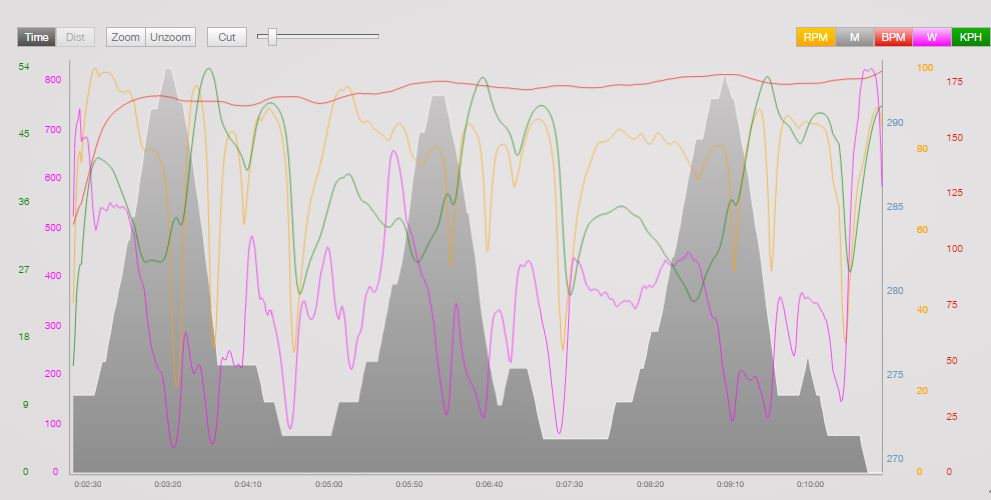
General information:
- Time: 8: 23min
- W NP: 373W (5,5W / kg)
- W AVG: 319W (4.7 W / kg)
- VI: 1.17
- HR avg: 170
- HR max: 181
- Length of the race: 3x1750m
Detailed data from rounds: 1/2/3
- W NP: 368/369/362
- W AVG: 334/330/363
- HR avg: 162/172/175
- CAD avg: 83/79/81
- VI: 1.10/1.12/1.00
- W/kg: 4.91/4.85/4.6
- PR: 38.2/38.4/37.8
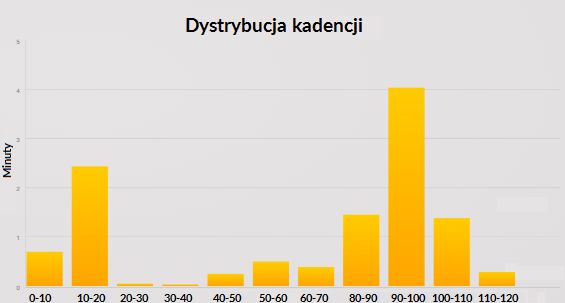
Conclusions:
- the beginning of the race was aggressive, both concerning power, cadence, and number of spurts
- the first two rounds were ridden relatively hard (4.8-4.9W/kg) with a large number of accelerations
- the last round with conscious energy saving before the sprint (4.6W/kg) and stabilized effort (without spurts) – VI 1.00
- it is worth observing how much time Piotr spent without pedaling (3:10min, or 38% of the race) – this indicates choosing the right tactics and optimal cycling technique in the group (saving energy where possible)
- the above allowed Piotr save precious “triggers” for the last round
- the final sprint is the maximum effort from the entire race (15sec, 12W/kg) resulting in a victory in the race